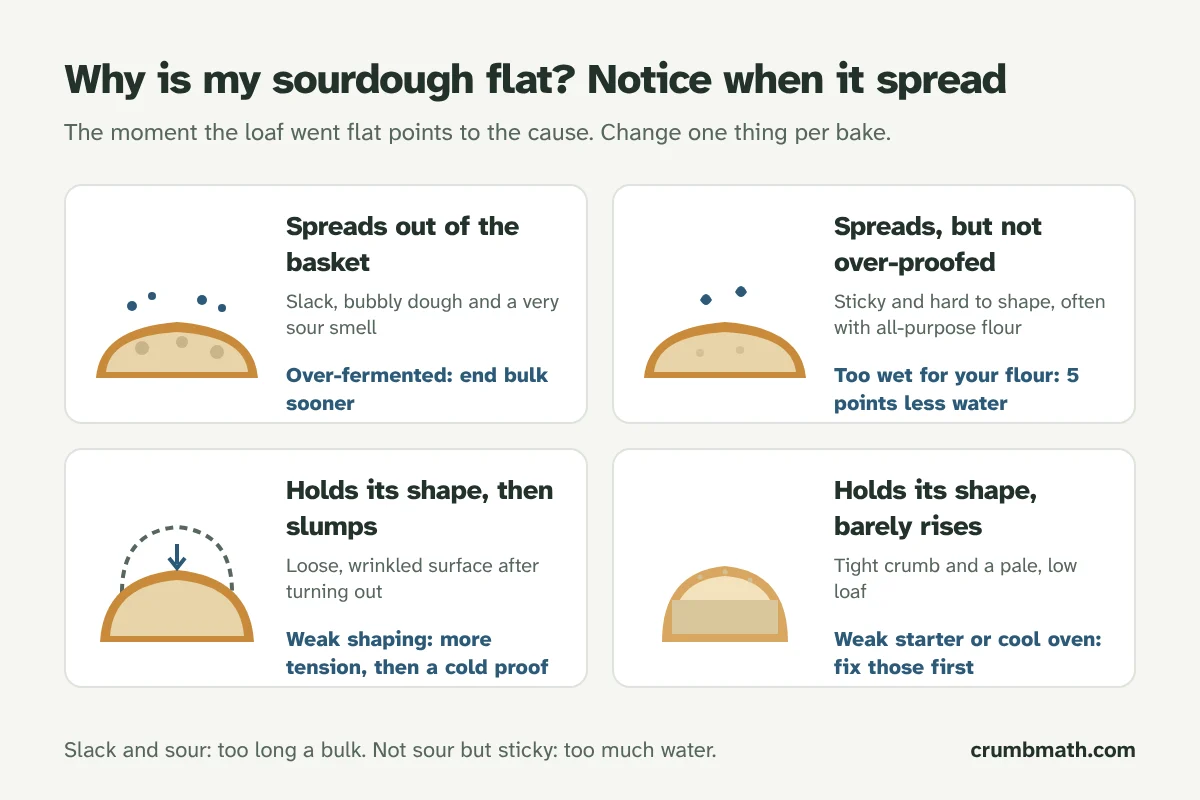
A flat loaf is one of the most common sourdough complaints, and it is frustrating because the dough often looked fine an hour earlier. The good news is that the moment it went flat says a lot about why. A loaf that spreads as soon as you turn it out of the basket has a different problem from one that holds its shape and then simply fails to rise in the oven.
Change one thing per bake, and write down your dough temperature and how far bulk rose. Otherwise you cannot tell which change helped.
First: when did it go flat?
| What happened | Most likely cause | Start here |
|---|---|---|
| It spread the moment it left the banneton, and the dough felt slack and sticky | Over-fermented | Too long a bulk |
| It spread out of the banneton, but the dough did not feel over-proofed | Too much water for your flour, or weak shaping | Too wet for your flour |
| It held its shape, then slowly slumped on the counter or peel | Not enough surface tension from shaping | Shaping |
| It held its shape but barely rose in the oven, and the crumb is tight | Weak starter, under-fermented, or the oven was not hot enough | Starter and oven |
Over-fermented: the most common cause
When dough ferments too long, the gluten weakens and the dough can no longer hold the gas or its shape. You Knead Sourdough calls over-proofing “the #1 culprit” for flat loaves, and the signs are hard to miss once you know them:
- Very slack, sticky dough at shaping that will not tighten up
- Lots of large bubbles on the surface, and a dome that has gone flat or collapsed
- A strong sour smell, and a loaf that spreads with little oven spring
The usual reason is temperature, not the clock. A warmer kitchen or warmer water speeds fermentation a lot, so a recipe’s bulk time can be far too long for your dough. A bulk of 5 hours at 75 °F (24 °C) can take only about 3.5 to 4 hours at 80 °F (27 °C), and about 7 to 8.5 hours at 68 °F (20 °C), by the rules of thumb in the bulk fermentation calculator.
How far to let bulk rise also varies a lot between recipes. Some guides aim for a rise of only 30% to 50%, while Ken Forkish’s books take dough to 2.5 to 3 times its size. Neither is wrong, but they assume different amounts of starter, flour and temperature. If you follow a big-rise recipe with all-purpose flour and your loaves spread, try ending bulk earlier, at around double, and see if it holds its shape better. An aliquot jar makes the rise easy to measure.
What to change: end bulk sooner, use cooler water, or use a little less starter. The overproofed vs underproofed guide shows how to tell before you bake, and how to rescue a loaf that has gone too far.
Too much water for your flour
A hydration that works in one kitchen can be too much in another. Lower-protein flour, like most all-purpose flour, absorbs less water and builds weaker gluten than bread flour, so a dough at 75% or 80% can turn slack and spread even when the timing was right. The hydration guide explains how different flours behave.
This is exactly the problem in a recent Fresh Loaf thread, where a baker using all-purpose flour with Forkish’s recipes found the dough flattened and spread when it came out of the banneton. The first suggestion was to lower the hydration until the loaf stopped spreading too much.
What to change: take 5 percentage points off the water and bake again. Remember that your starter’s water counts. With 450 g flour, 325 g water and 100 g of 100% starter, the dough is 75% hydration. To make it 70%, use 300 g of water instead of 325 g. The hydration calculator does this sum for any recipe, including stiff starters. Once the loaf holds its shape, you can add water back a little at a time.
Weak shaping: not enough tension
A shaped loaf holds itself up with a tight skin on the outside. If that skin is loose, the dough relaxes and slumps, even if fermentation and hydration were fine. Signs of a shaping problem:
- The loaf held its shape in the basket but sagged slowly after turning out
- The surface looks loose or wrinkled rather than smooth and taut
- The base spreads more than the top rises
What to change:
- Pre-shape into a round, let it rest 20 to 30 minutes, then shape again. The second shape builds more tension.
- Drag the shaped loaf toward you on an unfloured part of the counter to tighten the surface. If the dough tears, you have gone far enough.
- If you shape a batard, “stitch” it: fold the sides into the middle in overlapping folds, then roll it up tightly.
- Proof the shaped loaf in the fridge and bake it cold. Cold dough is firmer, holds its shape better when you turn it out, and is easier to score. The cold proof guide covers timing.
A basket that is too big for the dough also lets it spread before it reaches the oven. The banneton size guide matches dough weights to basket sizes.
A weak starter
A starter that does not rise reliably gives the dough too little lift, so the loaf rises slowly and stays low, usually with a tight crumb rather than a slack, spreading one. Before you change your recipe, check that the starter at least doubles within a predictable time after feeding. The starter not rising guide works through the usual fixes.
Under-fermented dough has the same look: the loaf barely rises and is dense in the bottom half. If the dough felt stiff and tight at shaping, the dense or gummy loaf guide is the better place to start.
A cool oven or pot
Most of a loaf’s rise happens in the first minutes in the oven. If the oven or Dutch oven is not fully hot, or there is no steam to keep the crust soft, the crust sets before the loaf can rise.
- Preheat the lidded pot inside the oven, not just the oven. Many bakers allow 45 minutes to an hour.
- Keep the lid on for the first 20 minutes so the steam stays in. The baking time guide has the times and temperatures for a pot, a loaf pan and a baking stone.
- Score the loaf. A good, confident cut gives it a place to open, so it rises up instead of bursting out of the side.
If you need a loaf now
If the dough is already too slack to hold a shape, bake it anyway. Tip it into an oiled loaf pan, which gives it the sides it no longer has, or press it into a pan as focaccia. The focaccia calculator shows how much dough suits your pan. It will taste fine, just more sour.
What to try first
| If the dough was | Try first |
|---|---|
| Slack, bubbly and very sour | End bulk sooner or use cooler water |
| Not over-proofed but sticky and hard to shape | 5 points less water |
| Firm enough, but the loaf sagged after turning out | A pre-shape and tighter final shape, then a cold proof |
| Slow and tight, and the loaf barely rose | Strengthen the starter before anything else |
Common questions
Why does my sourdough spread when I take it out of the banneton? It is usually over-fermented or too wet for your flour. If the dough was slack and very bubbly, end bulk sooner. If it was not, lower the hydration by about 5 percentage points or shape it more tightly.
Can all-purpose flour make sourdough flat? It can. All-purpose flour usually has less protein than bread flour, so it builds weaker gluten and holds less water. Many recipes written for bread flour need a little less water when you use all-purpose.
Will a cold proof stop my sourdough spreading? It helps. Dough straight from the fridge is firmer and easier to turn out and score, so it holds its shape better on the way into the oven. It will not fix dough that was already over-fermented.
Is flat sourdough safe to eat? Yes. A flat loaf is safe to eat. It may be denser and more sour than you wanted, and it still makes good toast.
Should I use a loaf pan instead? A loaf pan is a good way to get a tall loaf while you work on the cause, because the sides hold the dough up. The banneton size guide also covers pan sizes.