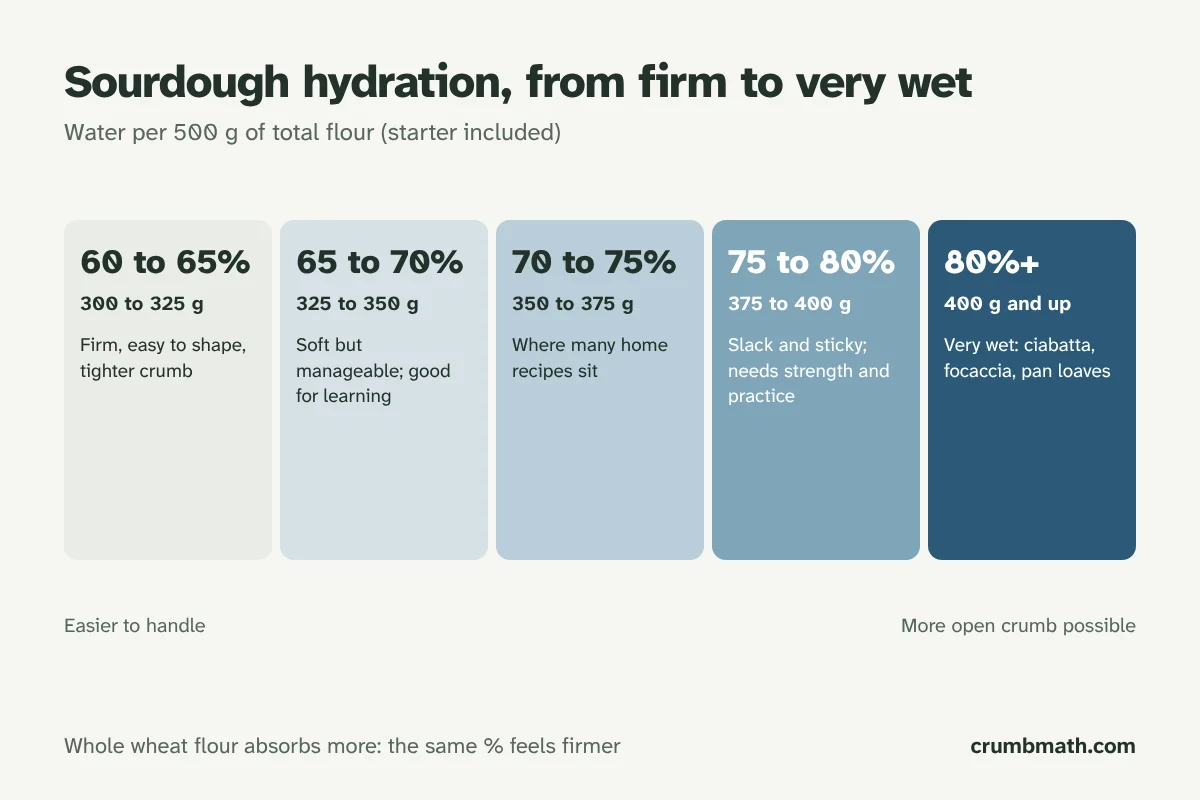
Hydration is the single number that tells you most about how a sourdough will behave in your hands. It is the weight of water in the dough divided by the weight of flour, written as a percentage. A 75% dough has 75 g of water for every 100 g of flour. Higher hydration means a wetter, slacker dough that is harder to shape but can give a more open crumb.
How to calculate it
The formula is simple:
Hydration = total water ÷ total flour × 100
The word total is where most people go wrong. Your starter is made of flour and water, so its share counts too. A 100% hydration starter is half flour and half water by weight.
Take a recipe with 450 g flour, 325 g water and 100 g of 100% starter:
- Water added divided by flour added: 325 ÷ 450 = 72.2%
- Counting the starter (50 g flour, 50 g water): 375 ÷ 500 = 75.0%
The recipe looks like a 72% dough but behaves like a 75% one. The hydration calculator does this split for any starter, including stiff ones.
What each hydration feels like
These are general guides for bread flour. The same number feels different with different flours, so treat them as a starting point.
| Hydration | Water per 500 g flour | What to expect |
|---|---|---|
| 60% to 65% | 300 g to 325 g | Firm and smooth. Easy to knead and shape; tighter, even crumb. Good for sandwich loaves and first bakes. |
| 65% to 70% | 325 g to 350 g | Soft but manageable. A forgiving range for learning shaping. |
| 70% to 75% | 350 g to 375 g | The range many home sourdough recipes use. Sticky at first, smooths out with folds. |
| 75% to 80% | 375 g to 400 g | Slack and sticky. Needs good dough strength and confident shaping; can give a more open crumb. |
| 80% and above | 400 g and up | Very wet. Typical of ciabatta and focaccia, often baked in a pan or shaped minimally. |
Flour changes everything
Different flours absorb different amounts of water. Whole wheat and freshly milled flours contain bran, which soaks up more water, so a 75% whole wheat dough often feels firmer than a 75% white flour dough. Lower-protein flours absorb less and can turn soupy at hydrations a strong bread flour handles comfortably.
That is why copying a recipe’s hydration with a different flour can go wrong. If you change flour, start a few points lower and adjust.
How to raise hydration gradually
If you want a more open crumb, raise hydration in small steps rather than jumping straight to 80%.
- Bake a loaf you can shape well, say at 70%.
- Next bake, add 2 to 3 percentage points.
- Hold back some of the water and add it during the first folds (a technique called bassinage). It is easier to build strength in a firmer dough first.
- Stop when shaping starts to fail, then work on technique before going higher.
The recipe calculator lets you set a target hydration and gives the grams of flour and water to add, with the starter already accounted for.
Common mistakes
- Ignoring the starter. The most common one; it makes doughs wetter than intended.
- Measuring water by volume. Use a scale; 1 ml of water weighs 1 g, so grams are easy.
- Changing flour and hydration at the same time. Change one thing per bake so you know what made the difference.
- Blaming hydration for under-fermentation. A dense, gummy loaf is more often under-proofed than over-hydrated.
Common questions
Is higher hydration always better? No. It is a trade-off between openness and handling. Many excellent loaves are 65% to 72%.
Does salt count? No. Salt is a separate baker’s percentage, usually about 2% of total flour.
What about milk or other liquids? Only the water content counts toward hydration. Milk is mostly water, but its fat and sugar also change how the dough behaves.