A dough that is too small for its basket spreads into a flat loaf, and one that is too big spills over the sides or sticks to the cloth. The fix is simple: size by the weight of the whole dough, not the flour, and not the basket’s measurements alone.
Banneton sizes by dough weight
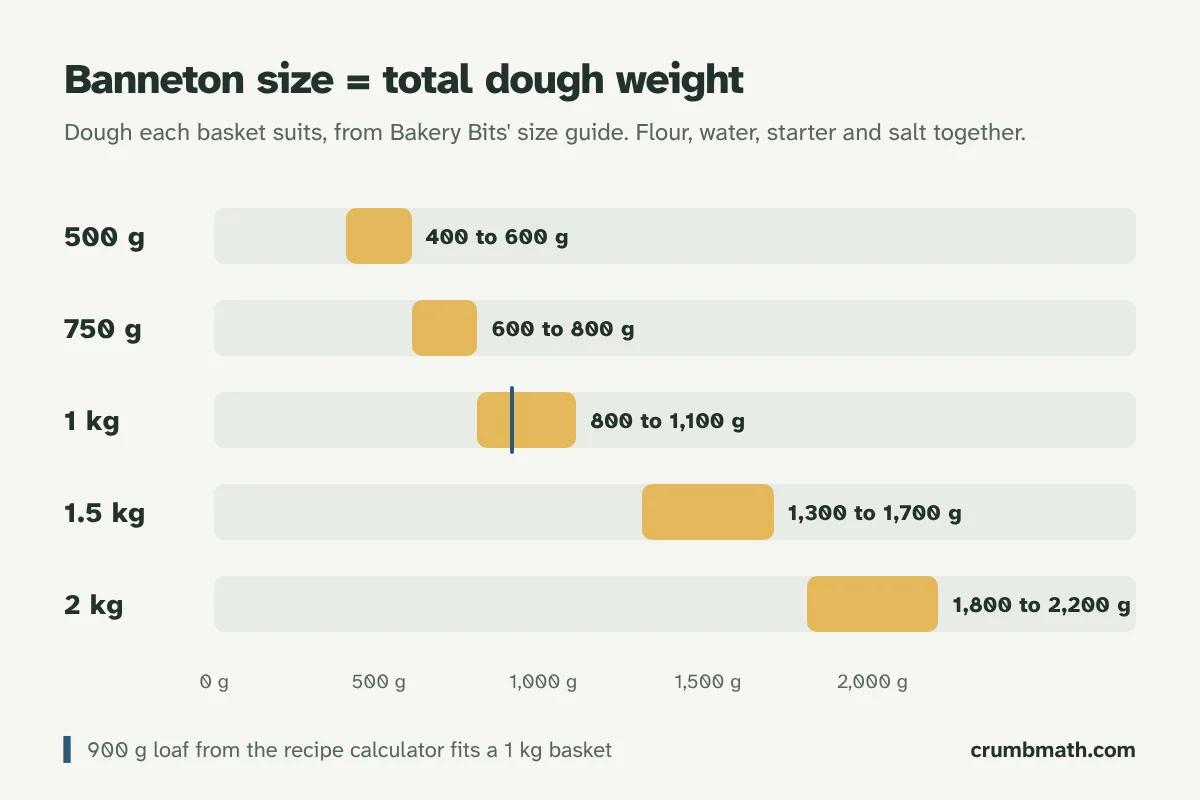
Many bannetons are sold by the dough weight they hold. The UK baking supplier Bakery Bits explains that the weight in a basket’s name is the dough weight, meaning everything in the dough added together. Its guide:
| Basket | Dough it suits |
|---|---|
| 165 g | about 130 to 200 g |
| 250 g | about 200 to 300 g |
| 500 g | about 400 to 600 g |
| 750 g | about 600 to 800 g |
| 1 kg | about 800 to 1,100 g |
| 1.5 kg | about 1,300 to 1,700 g |
| 2 kg | about 1,800 to 2,200 g |
Bakery Bits also notes that light, airy doughs rise more than dense ones with lots of wholemeal or rye, so a heavy whole grain dough can go in a slightly smaller basket.
If your banneton is sold by size in inches instead, Pantry Mama’s banneton size guide gives two useful reference points: a 9 inch oval suits about 600 g of dough and a 9 inch round about 850 g. When your dough falls between two sizes, Pantry Mama suggests choosing the smaller basket.
Work out your dough weight
Add up everything that goes into the dough: flour, water, starter and salt. Or let the recipe calculator do it the other way round: choose the dough weight that fits your basket, and it gives the grams of each ingredient.
Some examples, at 75% hydration, 20% starter and 2% salt:
| Dough | Fits | Flour to add | Water to add | Starter | Salt |
|---|---|---|---|---|---|
| 700 g | 750 g basket, 9 inch oval | 356 g | 257 g | 79 g | 8 g |
| 900 g | 1 kg basket, 9 inch round | 458 g | 331 g | 102 g | 10 g |
| 1,500 g | 1.5 kg basket | 763 g | 551 g | 169 g | 17 g |
For two loaves, set two loaves in the calculator and use one basket per loaf.
Loaf pan sizes
Loaf pans are less exact, and King Arthur says there is no hard-and-fast rule. Its guidance is by cups of flour; King Arthur weighs a cup of all-purpose flour at 120 g, which gives:
| Flour in the recipe | Pan |
|---|---|
| About 3 cups (360 g) or a little less | 8½ x 4½ inch |
| 3½ cups (420 g) | 9 x 5 inch for white or mixed flour; 8½ x 4½ for 100% whole grain |
| 3¾ cups (450 g) or more | 9 x 5 inch |
| 4 cups (480 g) or more | 10 x 5 inch or a pain de mie (Pullman) pan |
For sourdough, count the flour inside the starter too. The recipe calculator shows that as “total flour”. At 75% hydration and 2% salt, 360 g of total flour makes about 637 g of dough and 450 g about 797 g.
The two common pans are closer than they look. King Arthur notes that half an inch on each side changes the capacity by about 15%. If you only have a 9 x 5 inch pan and too much dough, it suggests filling the pan half to two-thirds full and shaping the rest into rolls.
As a check on a deep pan: King Arthur’s easy everyday sourdough bakes about 1,130 g of dough, plus salt, in a 9 x 4 x 4 inch pan, rising until it is within about an inch of the rim.
Dutch oven fit
The banneton shapes the loaf, but it still has to fit your pot. Pantry Mama notes that a 10 inch round banneton suits a 5 quart Dutch oven that is at least 11 inches across, and a 10 inch oval suits a 5 quart oval Dutch oven. If the loaf would touch the sides, use a smaller basket and a little less dough.
Common questions
Can I use a bowl instead of a banneton? Yes. A bowl lined with a well-floured cloth works. Pick one with roughly the same size and depth as the basket your dough weight calls for.
What happens if the banneton is too big? The dough has more room to spread sideways, so the loaf can bake flatter and wider. It still tastes the same.
Does the basket size include the starter? Yes. The weight is the whole dough: flour, water, starter and salt together.
What size banneton for 500 g of flour? At 75% hydration and 2% salt, 500 g of total flour is about 885 g of dough, which fits a 1 kg basket or a 9 inch round.