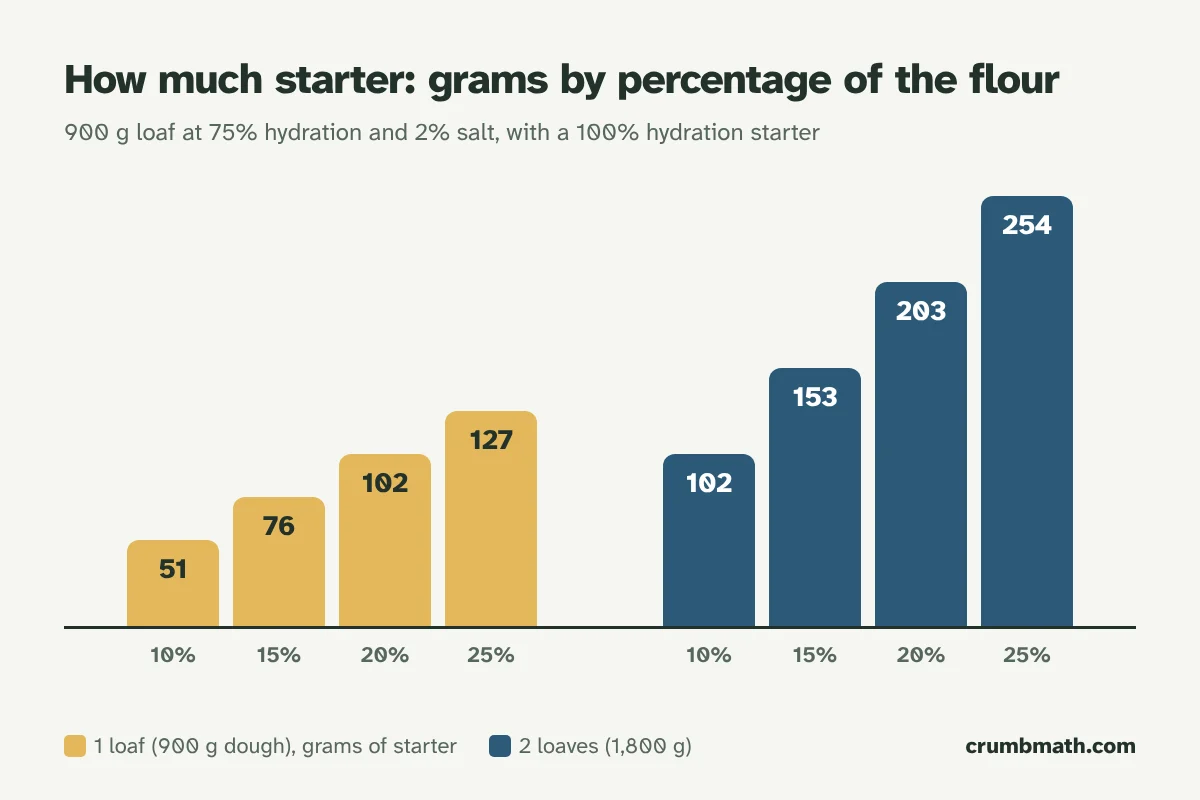
There is no single right amount of starter. Recipes use anywhere from a spoonful to a quarter of the flour’s weight, and all of them can make good bread. The amount you choose mainly sets how fast the dough ferments, so the useful question is how much starter suits your loaf size and your day.
Starter is measured against the flour
Bakers give starter as a percentage of the total flour: the flour you add plus the flour already inside the starter. This is the same convention the baker’s percentages guide explains. “20% starter” means the starter weighs one fifth of the total flour.
Most home recipes sit between 10% and 25%. Twenty percent is a common middle and the default in the recipe calculator.
How much starter for one loaf
For a typical 900 g loaf (about 2 lb of dough) at 75% hydration and 2% salt, with a 100% hydration starter, the total flour is about 508 g. That gives:
| Starter % | Starter | Flour to add | Water to add |
|---|---|---|---|
| 10% | 51 g | 483 g | 356 g |
| 15% | 76 g | 470 g | 343 g |
| 20% | 102 g | 458 g | 331 g |
| 25% | 127 g | 445 g | 318 g |
Salt is 10 g in every row. Notice that the flour and water you add go down as the starter goes up, because the starter brings its own flour and water. If you add more starter to a recipe without adjusting anything else, the dough gets bigger and slightly wetter than intended.
How much starter for 2 loaves
Two 900 g loaves is 1,800 g of dough, so everything doubles:
| Starter % | Starter | Flour to add | Water to add |
|---|---|---|---|
| 10% | 102 g | 966 g | 712 g |
| 15% | 153 g | 941 g | 686 g |
| 20% | 203 g | 915 g | 661 g |
| 25% | 254 g | 890 g | 636 g |
Salt is 20 g. For other sizes or a different hydration, set the number of loaves in the recipe calculator and it scales the whole recipe.
What more or less starter changes
Starter is the yeast and bacteria that raise the dough, so the amount mostly changes timing:
- More starter, faster bulk. Useful in a cold kitchen or when you want bread the same day.
- Less starter, slower bulk. Useful in a warm kitchen, or to stretch bulk fermentation overnight.
As a rough guide, The Sourdough Journey gives an example of a dough with 20% starter taking about 5 hours and the same dough with 10% taking about 8 hours at the same temperature. The bulk fermentation calculator uses that rule to adjust your own recipe’s time when you change the starter. Temperature has a bigger effect than starter, so treat any time as an estimate and judge the dough by how much it has risen.
Very high amounts (well above 25%) can make the dough ferment so fast it is hard to catch at the right moment, and the bread can taste more sour. Very low amounts work, but the bulk can run for many hours.
Make enough starter for the bake
Feed your starter so you have the amount you need plus a little to keep, and 10 to 20 g extra for what sticks to the jar. For two loaves at 20% you need about 203 g. Feeding 25 g of starter with 100 g flour and 100 g water gives 225 g, which covers the bake and leaves some to keep going. The starter feeding calculator turns any ratio into grams.
If you want to keep only a small starter, build a separate levain for the bake with the levain calculator.
Common questions
Can I use 50 g of starter instead of 100 g? Yes. That is about 10% for a 900 g loaf. Expect bulk fermentation to take noticeably longer, and add about 25 g flour and 25 g water to keep the same dough.
Does the starter need to be at its peak? It should be active: risen well and bubbly. Starter used well before or well after its peak tends to make bulk slower.
Do I count the starter in the hydration? Yes. The water inside the starter is part of the dough. The hydration calculator works out the true figure from your grams.
What if my starter is stiff? A 50% starter holds less water, so you add more water to the dough to reach the same hydration. Set the starter hydration in the recipe calculator and it adjusts the grams.