Baker’s percentages are a way of writing a bread recipe where the flour is always 100% and every other ingredient is a percentage of the flour’s weight. They let you scale any recipe to any size without rewriting it, and compare two recipes at a glance. Sourdough adds one twist: the starter contains flour and water too, and that is where most of the confusion comes from.
The basic idea
Take a simple dough: 1,000 g flour, 700 g water, 20 g salt.
| Ingredient | Grams | Baker’s percentage |
|---|---|---|
| Flour | 1,000 g | 100% |
| Water | 700 g | 70% |
| Salt | 20 g | 2% |
Each percentage is the ingredient’s weight divided by the flour’s weight. Notice the percentages add up to more than 100%; that is normal. They describe ratios to flour, not shares of the whole dough.
To scale this to 500 g of flour, multiply each percentage by 500: 350 g water, 10 g salt. No other arithmetic needed.
Where sourdough complicates it
A sourdough recipe adds starter, and the starter is itself flour and water. A 100% hydration starter is half flour and half water by weight. If you treat the starter as a separate ingredient and ignore what is inside it, your hydration number will be wrong.
Bakers handle this by using total flour: the flour you add plus the flour inside the starter. Hydration, salt and starter are all percentages of that total. This is the convention the recipe calculator uses, so the hydration you choose is the hydration you get.
A full worked example
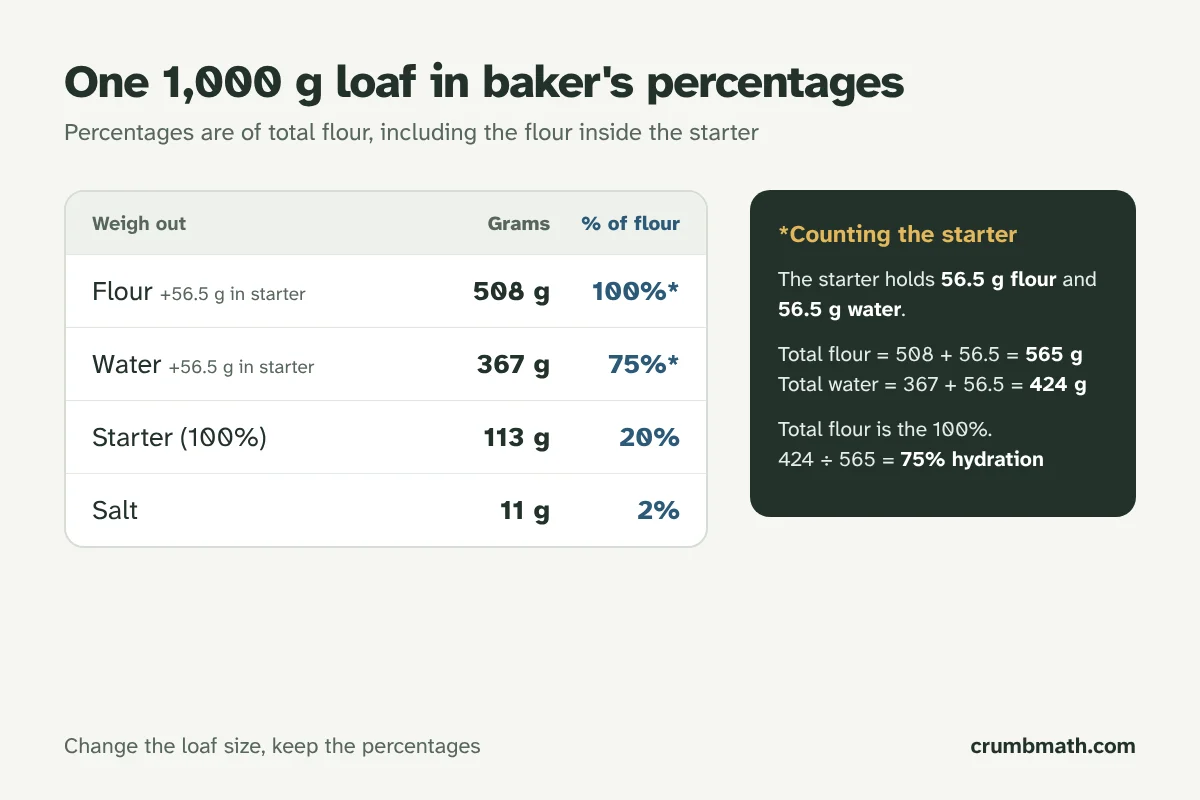
Say you want a 1,000 g loaf at 75% hydration, 20% starter and 2% salt, with a 100% hydration starter.
- Add the percentages that make up the dough: 100% flour + 75% water + 2% salt = 177%. (The starter is not added separately, because its flour and water are already counted in the 100% and the 75%.)
- Total flour = 1,000 ÷ 1.77 = 565 g.
- Total water = 565 × 0.75 = 424 g. Salt = 565 × 0.02 = 11 g.
- Starter = 565 × 0.20 = 113 g, which holds 56.5 g flour and 56.5 g water.
- Flour to add = 565 − 56.5 = 508 g. Water to add = 424 − 56.5 = 367 g.
You weigh out 508 g flour, 367 g water, 113 g starter and 11 g salt, which comes back to 999 g, the extra gram lost to rounding.
Reading a recipe written in percentages
When a recipe gives percentages, check two things before you trust its hydration:
- Is the starter’s flour included? If a recipe lists “water 70%” next to “starter 20%” without saying so, the true hydration may be higher. The hydration calculator tells you the real number from the grams.
- What hydration is the starter? A 50% stiff starter brings far less water than a 100% one. The same percentages give a different dough.
Typical ranges
These are common in home sourdough recipes, not rules:
| Ingredient | Common range (of total flour) |
|---|---|
| Water (hydration) | about 65% to 80% |
| Starter | about 10% to 25% |
| Salt | about 1.8% to 2.2% |
More starter makes fermentation faster; less makes it slower, which can suit warm kitchens or overnight schedules.
Common questions
Why do the percentages add to more than 100%? Because everything is measured against the flour, which is fixed at 100%. Only the flour’s share is 100%.
Is starter percentage the same as “prefermented flour”? No. Starter percentage is the starter’s whole weight compared with total flour. Prefermented flour is just the flour inside the starter. With a 100% starter at 20%, the prefermented flour is 10% of the total. The recipe calculator shows both.
Can I use percentages for whole wheat or rye? Yes. Every flour counts toward the 100%. Just remember whole grain flours absorb more water, so the same hydration feels firmer.