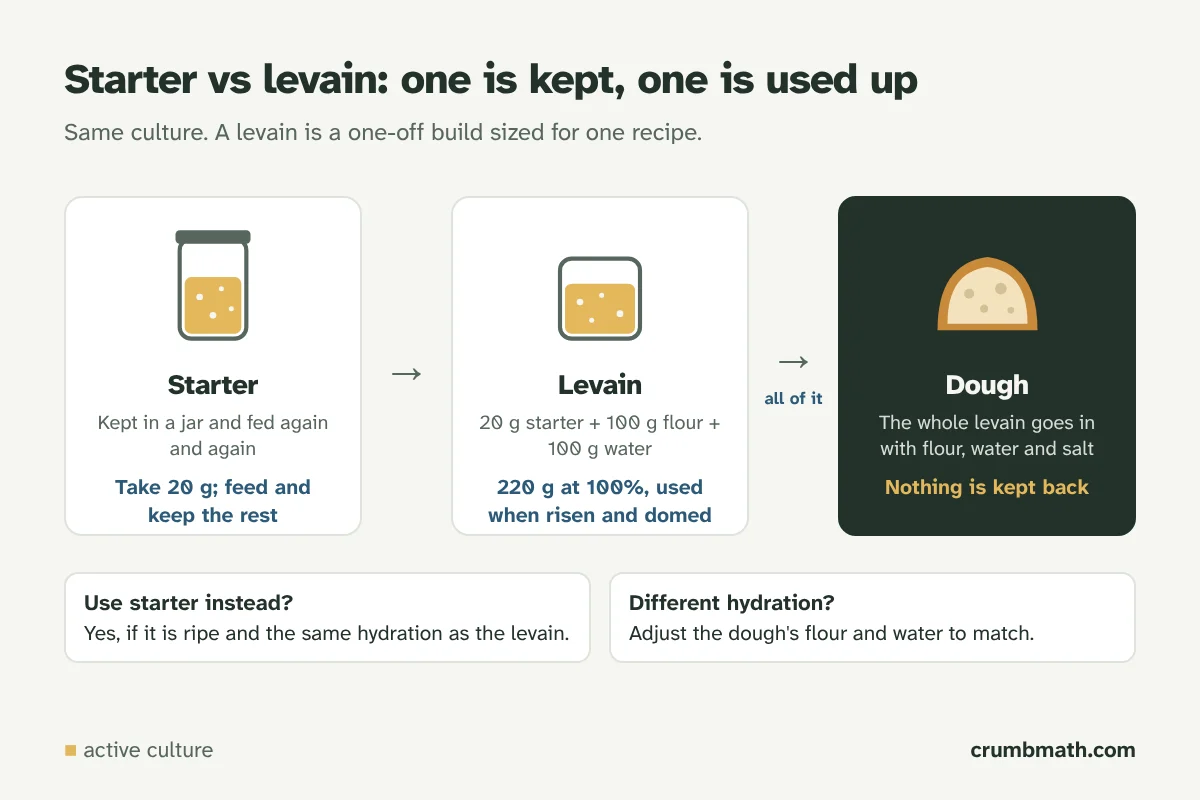
Recipes use “starter” and “levain” in ways that are easy to mix up, and some bakers use the two words for the same thing. The difference is simple once you see it: one is kept, the other is used up.
The short version
| Starter | Levain | |
|---|---|---|
| What it is | The culture you keep and feed | A build made from a little starter, fresh flour and water |
| How long it lives | Indefinitely | One bake |
| Size | Whatever is convenient to keep | Exactly what the recipe needs |
| Hydration and flour | Whatever you always feed it | Whatever this recipe asks for |
| What happens to it | Some is used, the rest is fed again | All of it goes into the dough |
The Perfect Loaf puts it the same way: the starter is maintained continuously and never fully used up, while a levain is an offshoot made for a single batch of dough.
You will also see other names. “Mother”, “chef” and “leaven” usually mean one of these two, but bakers do not agree on exactly which. A long Fresh Loaf thread on starter vs levain shows experienced bakers using the words differently. When a recipe is unclear, look at what it does: if it is built the night before and all of it goes into the dough, treat it as a levain.
Why recipes build a levain
A levain is not a different organism. It is the same yeast and bacteria, fed for one purpose. Recipes use one for a few practical reasons:
- Size. You can keep 50 g of starter and still bake two loaves that need 200 g of levain.
- Hydration or flour. The recipe may want a stiff levain, or one with whole wheat or rye, without you changing how you keep your starter.
- Timing. The amount of starter in the build sets when the levain is ready, so you can fit it around your day. The schedules guide uses a small seed so a levain built before work is ready in the evening.
- Protecting the starter. If something goes wrong with the levain, your starter is still in its jar.
Can you use starter instead of levain?
Usually, yes. The Perfect Loaf says a starter can stand in for a levain, especially in a pinch, though the flavor may differ a little from what the recipe intended.
It works without any changes when two things are true:
- Your starter is ripe. Use it near its peak, a few hours after feeding, when it has risen well and domed, the same stage the recipe expects of its levain.
- The hydration matches. Most levains in home recipes are 100% hydration (equal flour and water), and so are most starters.
If both are true, use the same weight of starter as the recipe’s levain. You will need enough: if the recipe wants 200 g of levain and you keep 60 g of starter, build a levain or feed the starter up the day before.
When the hydration does not match
If a recipe asks for a stiff levain at 50% and you use a 100% starter in its place, the dough gets wetter. The two bring different amounts of flour and water:
| 100 g of… | Flour | Water |
|---|---|---|
| Stiff levain at 50% hydration | 66.7 g | 33.3 g |
| Starter at 100% hydration | 50 g | 50 g |
| Difference | 16.7 g less | 16.7 g more |
So to swap 100 g of 100% starter for 100 g of 50% levain, add about 17 g more flour and use about 17 g less water in the dough. Swapping the other way, a stiff starter for a liquid levain, means the opposite: less flour, more water.
The recipe calculator does this for you. Enter the starter’s real hydration and it adjusts the flour and water to add.
Or build a stiff levain from your liquid starter. The levain calculator counts the starter’s own water: for 165 g of 50% levain with a 20% seed, mix 20 g starter, 100 g flour and 45 g water.
How to build a levain from your starter
Decide how much levain the recipe needs, add a little for what sticks to the jar, then choose how much starter to seed it with. The seed sets the timing:
| Build (starter : flour : water) | For 200 g of 100% levain | Ready in |
|---|---|---|
| 1 : 1 : 1 | 67 g starter, 67 g flour, 67 g water | About 3 to 4 hours at 78 to 80°F (25 to 26°C), per The Perfect Loaf |
| 1 : 5 : 5 | 18 g starter, 91 g flour, 91 g water | Much slower, often overnight in a cool kitchen |
Times vary a lot with temperature, flour and how lively your starter is, so treat them as a starting point and judge by the rise. For other sizes, hydrations and seed amounts, use the levain calculator. The feeding ratios guide explains why a bigger seed ripens faster.
Common questions
Is levain the same as sourdough starter? They contain the same culture. The difference is the job: the starter is kept and fed, a levain is built for one bake and used up.
Can I keep some of my levain as my new starter? Yes, as long as you have not added salt or anything else to it. Some bakers do this on purpose and keep the leftover levain as next time’s starter.
Does a levain make bread more sour than a starter? Not by itself. Flavor depends more on the flour, the hydration, the temperature and how ripe the levain is when you use it. The Perfect Loaf notes that a levain with more whole grain flour tends to give a more sour loaf.
Do I need a levain for discard recipes? No. Discard recipes use unfed starter. See the discard guide.