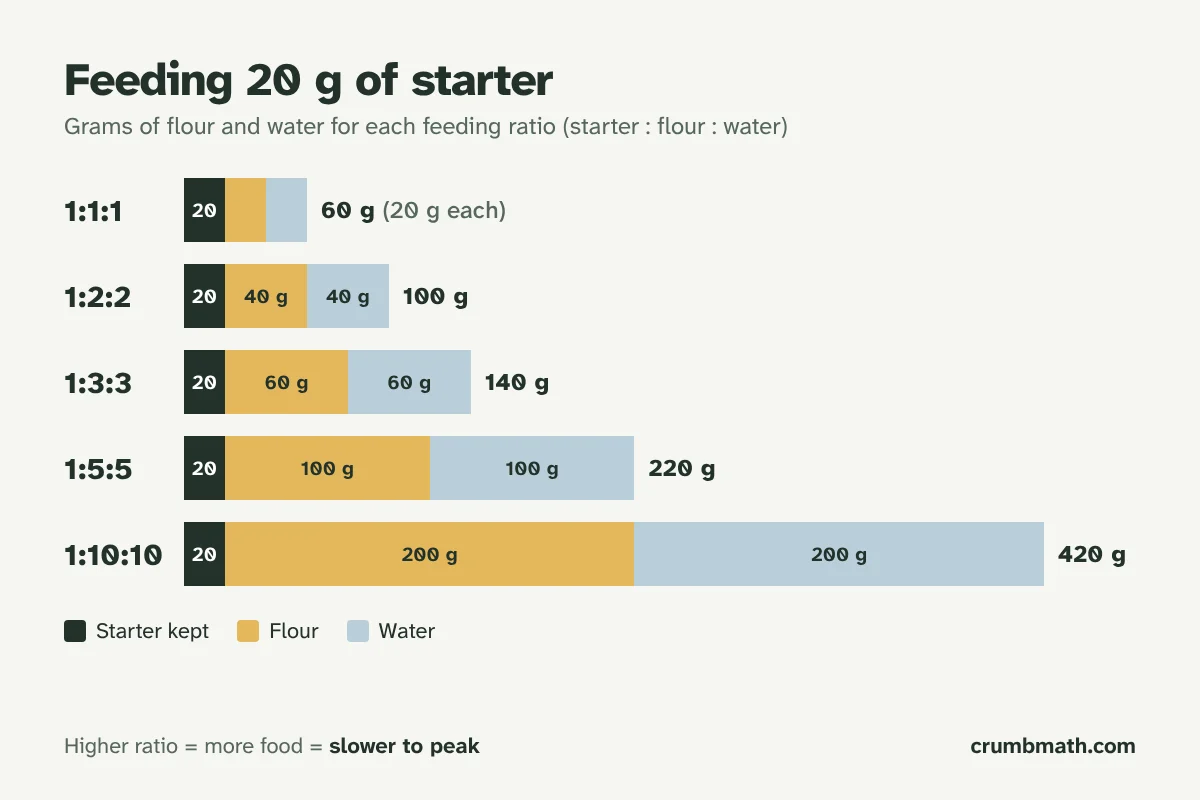
A feeding ratio tells you how much fresh flour and water to give your starter compared with the starter you keep. The bigger the ratio, the more food the yeast and bacteria have to work through, and the longer the starter takes to rise and peak. That one idea is all you need to pick a ratio that fits your day.
What the three numbers mean
A ratio like 1:5:5 is read as starter : flour : water, all by weight:
- 1 part existing starter (often called the seed or inoculation)
- 5 parts flour
- 5 parts water
Feed 20 g of starter at 1:5:5 and you add 100 g of flour and 100 g of water, ending up with 220 g. The ratio does not care about the amount; 10 g at 1:5:5 means 50 g of flour and 50 g of water.
Always weigh. A spoonful of bubbly starter weighs much less than a spoonful of settled starter, which is enough to throw the ratio off.
The common ratios in grams
Feeding 20 g of starter:
| Ratio | Starter | Flour | Water | You end up with |
|---|---|---|---|---|
| 1:1:1 | 20 g | 20 g | 20 g | 60 g |
| 1:2:2 | 20 g | 40 g | 40 g | 100 g |
| 1:3:3 | 20 g | 60 g | 60 g | 140 g |
| 1:5:5 | 20 g | 100 g | 100 g | 220 g |
| 1:10:10 | 20 g | 200 g | 200 g | 420 g |
Making about 100 g of starter in total:
| Ratio | Starter | Flour | Water |
|---|---|---|---|
| 1:1:1 | 33 g | 33 g | 33 g |
| 1:2:2 | 20 g | 40 g | 40 g |
| 1:5:5 | 9 g | 45.5 g | 45.5 g |
| 1:10:10 | 5 g | 47.5 g | 47.5 g |
Notice how little seed the higher ratios need. That is why bakers who keep a small jar of starter can still build a large, slow feed overnight.
How the ratio changes timing
When you feed a starter, the existing population of wild yeast and bacteria has to grow through the fresh flour before the starter rises to its peak. With a 1:1:1 feed there is relatively little new food per microbe, so the starter peaks sooner. With 1:10:10 the same culture is diluted into ten times as much flour, so it takes much longer.
Temperature moves timing just as much. A warm kitchen speeds every ratio up; a cool one slows them all down. That is why no chart can tell you that “1:5:5 takes eight hours”: it depends on your room, your flour and your particular starter. What stays true is the order. Higher ratio, slower peak. Warmer room, faster peak.
Choosing a ratio
Pick the ratio that makes your starter peak when you need it.
- You feed twice a day in a cool kitchen: 1:1:1 or 1:2:2 keeps the starter lively without long waits.
- You feed once a day, or your kitchen is warm: 1:5:5 stretches the time to peak so the starter is not sitting collapsed for hours.
- You want it ready in the morning after an overnight feed: a high ratio such as 1:10:10 slows things down enough to bridge the night, especially in summer.
- Your starter has been sluggish: smaller, more frequent feeds (1:1:1 or 1:2:2) at a warm spot often bring it back faster than a big dilution.
If your starter peaks too early, raise the ratio next time. If it is still rising when you need it, lower the ratio or find a warmer spot. Two or three feeds of adjusting is usually enough to find your rhythm.
Feeding changes hydration too
If you feed equal weights of flour and water (5:5, 2:2, 1:1), your starter stays at 100% hydration. If you feed less water than flour, say 1:5:2.5, the starter gets stiffer, because the seed’s own flour and water are mixed in with the fresh feed.
Feeding 20 g of a 100% starter at 1:5:2.5 is easier to see with the numbers: the seed holds 10 g of flour and 10 g of water, so the result is (50 + 10) ÷ (100 + 10) = about 55% hydration. Stiff starters rise more slowly and taste a little different, which some bakers prefer. The starter feeding calculator shows the hydration you end up with for any ratio.
How to tell your starter is ready
Go by the starter, not the clock. A starter at or near its peak usually:
- has clearly risen, often doubled or more, depending on the flour
- has a domed top, or one that is just starting to flatten
- is full of bubbles through the jar, not only on the surface
- smells pleasantly sour and yeasty rather than sharply of acetone
A rubber band around the jar at the starting level makes the rise easy to judge.
Common questions
Do I have to discard? If you keep feeding without discarding, the amount doubles or more every feed. Discarding keeps the jar a sensible size; the ratio is what decides how much fresh flour the remaining starter gets.
Can I use different flours? Yes. Whole grain and rye flours often make a starter more active, and they absorb more water, so a 100% whole wheat starter feels thicker than a 100% white flour one.
Does the ratio affect the bread? Indirectly. What matters to the bread is using the starter near its peak. The ratio is simply the tool for getting it there at the right time.