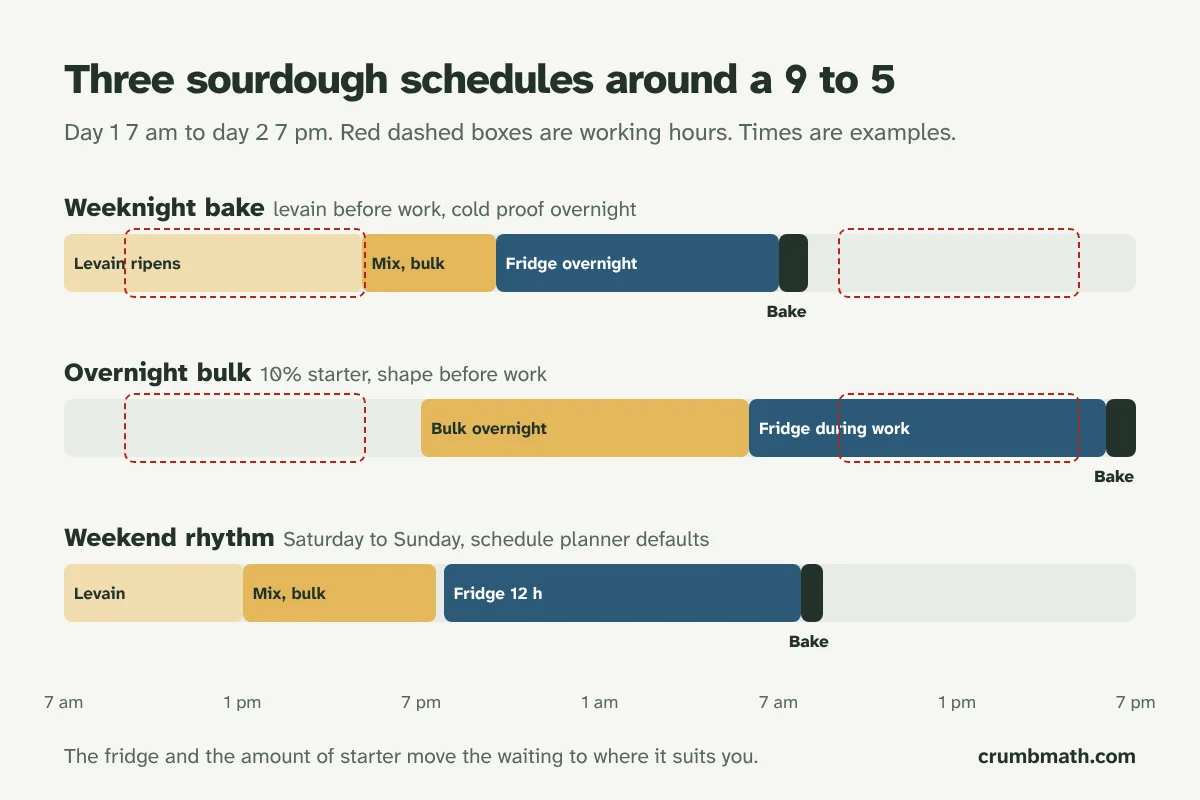
Most sourdough recipes are written as if you are home all day. You are not, and you do not need to be. Sourdough mostly needs time, not attention, and two tools let you move that time to where it suits you: how much starter you use (less starter, slower dough) and the fridge (cold dough barely moves, so it waits for you).
Below are three schedules that fit around a 9 to 5. The clock times are examples. Fermentation speed depends mainly on temperature, so treat every time as a starting point and judge the dough by how much it has risen.
Schedule 1: weeknight bake, cold proof overnight
This is the rhythm The Perfect Loaf uses in its simple weekday sourdough, with the dough at about 75 °F (24 °C):
| Time | Step |
|---|---|
| 7:00 am, before work | Build the levain. It ripens over about 10 hours. |
| 5:00 pm | Mix flour and water, rest 20 minutes. |
| 5:30 pm | Add levain and salt. Bulk ferment, with folds in the first hour. |
| 9:00 pm | Divide and pre-shape. |
| 9:30 pm | Shape and put in the fridge. |
| 7:00 am, next day | Bake before work, or leave it in the fridge and bake after work. |
Why it works: the levain does its slow part while you are out, and the cold proof covers the night. Bulk here is about 3.5 hours at that dough temperature. In a cooler kitchen bulk takes longer, so either warm the dough with the water temperature calculator or expect a later bedtime.
To make the levain last a working day, it needs less seed than a levain you would use in 4 or 5 hours. The levain calculator lets you lower the seed percentage and still hit the weight your recipe needs.
Schedule 2: overnight bulk, shape before work
If your evenings are short, let bulk run while you sleep. This only works with much less starter, so the dough does not overshoot by morning.
Using the bulk fermentation calculator: a recipe that usually bulks for 5 hours at 24 °C (75 °F) with 20% starter takes roughly 10 to 12 hours with 10% starter at 21 °C (70 °F). That fits a night:
| Time | Step |
|---|---|
| 7:00 pm | Mix with 10% starter. A couple of folds in the first hour. |
| Overnight | Bulk at room temperature. |
| About 6:00 am | Check the rise. If it is ready, shape and put in the fridge. |
| 6:00 pm, after work | Bake straight from the fridge. |
This is the least predictable of the three, because you cannot watch the dough at 3 am. A small sample in an aliquot jar shows exactly how far the dough has risen when you wake up. If your kitchen is warmer than 21 °C at night, use less starter; if it is colder, the calculator will show bulk running well past morning, and Schedule 1 is the better choice.
Schedule 3: the weekend rhythm
If you would rather bake only on days off, this is the default in the schedule planner: about 6 hours for the levain, 1 hour rest, 5 hours bulk, shaping in the evening, and a 12-hour cold proof.
| Time | Step |
|---|---|
| Saturday 7:00 am | Feed the starter or build the levain. |
| 1:00 pm | Mix flour and water, rest. |
| 2:00 pm | Add starter and salt. Bulk ferment. |
| 7:00 pm | Pre-shape, then shape at 7:30 pm. |
| 7:45 pm | Into the fridge. |
| Sunday 7:45 am | Bake. Bread is cool enough to slice at about 9:30 am. |
A starter kept in the fridge during the week usually needs a feed or two to get going again first. The guide to feeding a starter from the fridge covers that, so feed it Friday evening if it has been sitting all week.
Make any schedule your own
- Set the anchor. Put in when you want bread, or when you can start, and the schedule planner works out every clock time. It can also add the steps to your calendar.
- Use starter to change bulk. Less starter stretches bulk, more shortens it. The starter guide shows the grams.
- Use the fridge as a pause. A shaped loaf can wait in the fridge if your day runs late. The Perfect Loaf notes its dough can stay in the fridge longer so you can bake when you have time.
- Write down what happened. Note the dough temperature and how long bulk really took. After two or three bakes your own times will be far more useful than any recipe’s.
Common questions
Can I leave sourdough dough out while I’m at work? For a full working day at room temperature, only with very little starter or a cool room, and it is easy to overshoot. Putting shaped dough in the fridge is the safer way to cover 9 hours or more.
How long can shaped dough stay in the fridge? Many recipes use an overnight cold proof of around 12 hours, and some go longer. How long yours can wait depends on your dough and how cold your fridge is, so try extending it a little at a time.
Can I bake the same evening? Yes, if you shape early enough. The Perfect Loaf says its shaped dough needs only a few hours in the fridge before baking.