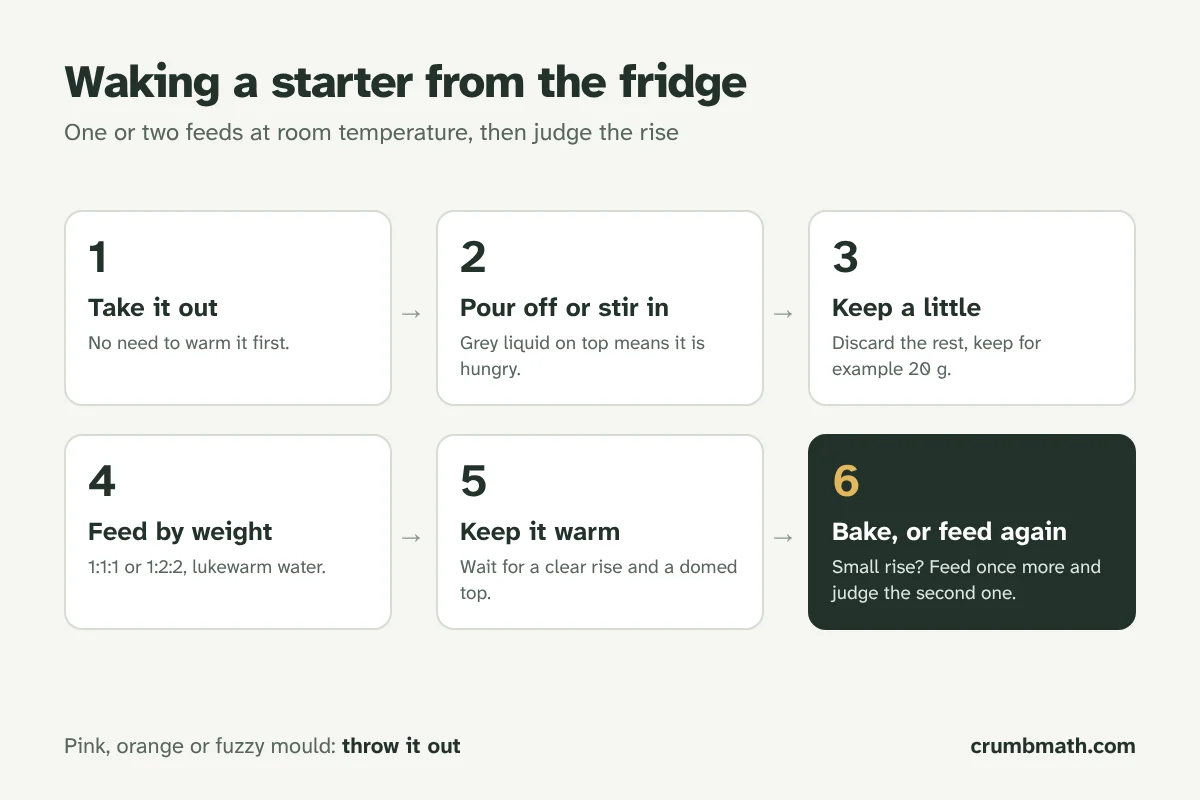
A starter kept in the fridge is not dead, just slow. Cold slows the yeast and bacteria right down, so a fridge starter can go a week or more between feeds. To bake with it, you bring it back to full activity with one or two feeds at room temperature. Here is how to do that without guesswork.
The short version
- Take the jar out of the fridge.
- Pour off or stir in any grey liquid on top.
- Keep a small amount of starter and discard the rest.
- Feed it fresh flour and water by weight, using lukewarm water.
- Keep it somewhere warm and wait for it to rise and peak.
- If it is sluggish, feed it once more before you bake.
Do you need to warm it up first?
No. You can feed it cold, straight from the fridge. The fresh flour and water will warm it, especially if the water is lukewarm. Leaving the jar out for an hour first does no harm, but it is not required.
What matters more is the temperature it sits at after feeding. A starter that was cold for days will be slow on its first feed, and a warm spot helps it catch up. If you want to control that precisely, the water temperature calculator works out how warm your water needs to be to hit a target temperature.
Which ratio to feed
For the first feed after the fridge, a modest ratio usually works best. A cold, hungry starter has a smaller active population, so diluting it heavily makes it take a long time to rise.
| Situation | First feed | Example with 20 g kept |
|---|---|---|
| A few days in the fridge | 1:2:2 | 40 g flour, 40 g water |
| One to two weeks in the fridge | 1:1:1 | 20 g flour, 20 g water |
| Several weeks, or very sluggish | 1:1:1, then a second feed | 20 g flour, 20 g water, twice |
Once it rises well and predictably again, go back to your usual ratio. The starter feeding ratios guide explains how the ratio changes timing, and the starter feeding calculator gives the grams for any amount.
The grey liquid on top
That layer of grey or brownish liquid is often called hooch. It forms when a starter has used up its food. It is a sign of hunger, not of spoilage. You can pour it off for a milder flavour or stir it back in for a more sour one; either way, feed the starter.
When to throw it away
Throw the starter out if you see pink, orange or fuzzy mould on the surface or the sides of the jar, or if it smells rotten rather than sour. Do not try to scrape mould off and keep going. A sharp smell like nail polish remover, on the other hand, is a sign of hunger and usually clears after a feed or two.
How to tell it is ready
A revived starter is ready to bake with when it rises clearly after feeding and peaks in a predictable time. Look for a domed top, bubbles all the way through the jar and a pleasantly sour smell. If the first feed only gives a small rise, that is normal after a long rest; feed it again and judge the second rise.
Putting it back in the fridge
Many bakers feed the starter, leave it out for an hour or so to get going, then return it to the fridge. A thicker, stiffer feed keeps longer in the cold because the starter uses its food more slowly. If you bake once a week, a simple routine is: feed and refrigerate after baking, then revive it a day before the next bake.
Common questions
My starter did not rise after the first feed. Is it dead? Almost certainly not. A starter that has been cold for a long time often needs two or three feeds at room temperature before it rises strongly again.
Can I use it for baking straight from the fridge? Not usually. Cold, unfed starter is weak and acidic, and dough made with it tends to rise slowly. Feed it first and use it near its peak.
How long can it stay in the fridge? Bakers commonly leave a fed starter in the fridge for a week or two between feeds. Longer is possible, but expect more feeds to revive it.