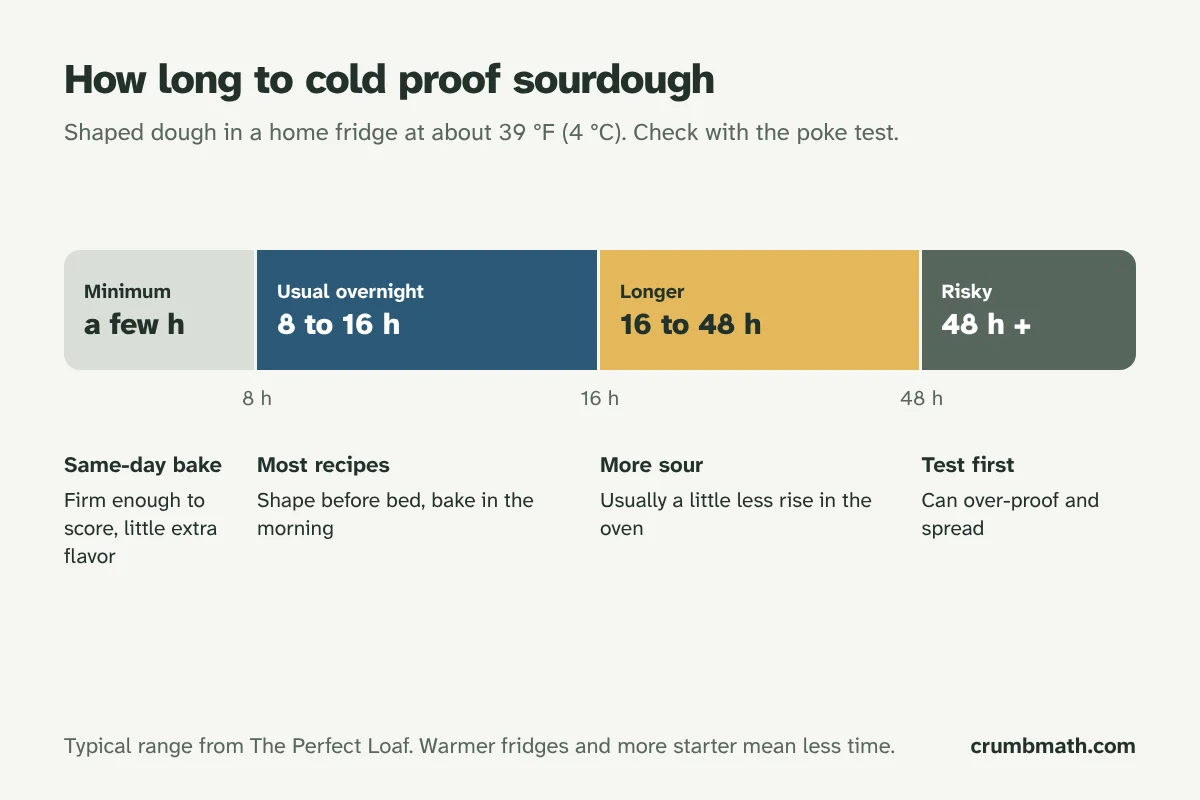
Cold proofing, also called retarding, means putting the shaped loaf in the fridge for its final rise. It is the step that makes sourdough fit around a normal day: the cold slows fermentation right down, so the dough waits for you instead of the other way round. The question everyone asks is how long it can stay there.
The short version
| Time in the fridge | What to expect |
|---|---|
| A few hours | Enough for some recipes to bake the same evening. Less flavor change. |
| 8 to 16 hours | The usual overnight proof. The range The Perfect Loaf gives for most doughs. |
| 16 to 48 hours | Often still fine. More sour, and usually a little less rise in the oven. |
| More than 48 hours | Possible, but the risk of an over-proofed, flat loaf grows. Test before you try it with a bake that matters. |
The Perfect Loaf’s guide to proofing puts the typical cold proof at 8 to 16 hours, depending on the temperature, and its author says he has left dough in the fridge for up to 48 hours. Some San Francisco-style sourdough recipes go further, with 48 to 72 hour cold proofs, as noted in a Fresh Loaf discussion.
Why the fridge works
Fermentation slows a lot as dough gets colder. A typical home fridge is around 39 °F (4 °C), according to The Perfect Loaf, and at that temperature the yeast and bacteria in sourdough keep working, just very slowly. The dough keeps rising a little and keeps developing flavor, but nowhere near as fast as on the counter.
That is also why there is no single answer. A fridge at 36 °F slows dough more than one at 43 °F. A dough that went in after a long, warm bulk ferment has less time to spare than one shaped a little early. A loaf with more starter moves faster than one with less.
What changes the longer it stays
- Flavor. Longer cold proofs tend to taste more sour and more complex. This is the main reason some bakers stretch them on purpose.
- Oven spring. The longer the dough waits, the more it uses up its strength and food, so very long proofs usually rise a little less in the oven.
- The crust. Cold-proofed loaves often bake with small blisters on the crust, which many bakers like.
- Scoring. Cold dough is firmer, so it is easier to score cleanly straight from the fridge.
How to tell if it’s ready: the poke test
Flour a finger and press it gently into the dough. The Perfect Loaf’s guide describes what to look for:
- Springs back slowly and not all the way: ready to bake.
- Springs back quickly and completely: it needs more time.
- Doesn’t spring back at all: it is over-proofed. Bake it anyway, as soon as you can; it will be flatter but still good to eat.
The test is a guide, not a precise reading. After a few bakes you will learn what ready feels like with your own fridge.
Bake straight from the fridge or warm it up?
Either works. The Perfect Loaf notes that cold-proofed dough is typically baked straight from the refrigerator or after being brought up to room temperature. Baking it cold is the simpler habit and makes scoring easier. If the poke test says it is under-proofed, leaving it on the counter for an hour or so first gives it a little more time.
How short can a cold proof be?
Shorter than you might think. The Perfect Loaf’s weekday sourdough author says in the comments that shaped dough needs only a few hours in the fridge before baking, which is enough to firm it up for scoring. A short cold proof adds less flavor, but it means you can mix in the afternoon and bake the same evening.
Fitting it around your week
The cold proof is the flexible step, so plan around it:
- Mix and bulk in the evening, shape before bed, and bake in the morning. The sourdough schedule planner gives you the clock times.
- If your plans change, an extra day in the fridge is usually better than baking at a bad time. Expect a more sour loaf.
- If bulk ran long or the kitchen was warm, the dough has less time to spare in the fridge. Check it earlier.
Focaccia often rises in the pan in the fridge too. King Arthur’s sourdough focaccia rises in the fridge for 14 to 16 hours, and the focaccia calculator works out how much dough your pan needs.
Common questions
Can I cold proof sourdough for 24 hours? Usually, yes. It sits between the typical overnight proof and the 48 hours The Perfect Loaf author has used. Expect a more sour loaf with a little less rise.
Can I cold proof for 3 days? Some recipes go to 72 hours, but it is at the edge. The dough may over-proof and spread. Try it once with a loaf you don’t mind experimenting on.
Should I cover the dough in the fridge? Yes. Cover the banneton or bowl, or put it in a bag, so the surface doesn’t dry out and form a skin.
My loaf came out of the fridge flat and spread. Why? It was probably over-proofed: too long in the fridge, a warm fridge, or a bulk ferment that ran too far before shaping. The dense or gummy loaf guide helps you tell the causes apart.