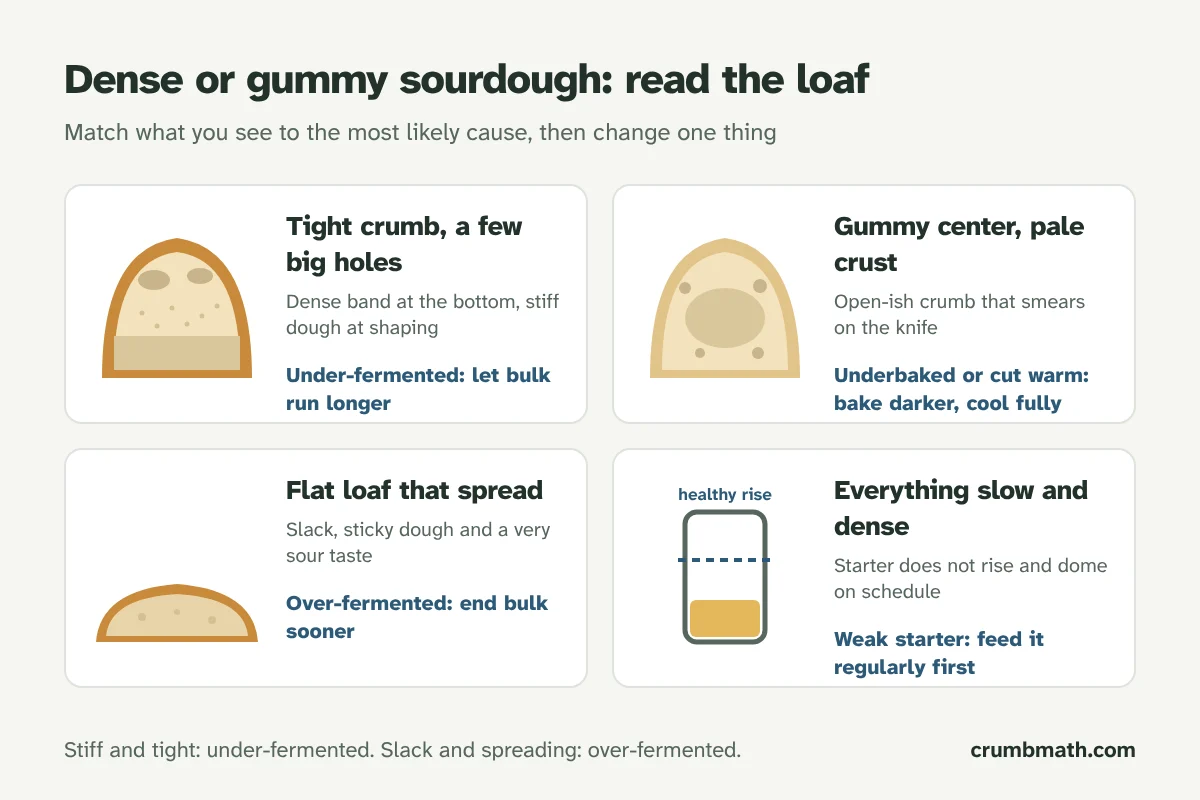
A dense or gummy loaf is the most common sourdough complaint, and it is frustrating because several different mistakes produce bread that looks similar. The good news is that the loaf usually leaves clues. Look at the crumb, the crust and how the dough behaved before you change anything.
Start with the most likely cause: under-fermentation
If you only change one thing, let bulk fermentation run longer. Under-fermented dough has not built enough gas or loosened enough gluten, so it bakes up tight.
Signs:
- A tight, close crumb, often with a denser, gummy band near the bottom
- A few large, shiny holes near the top crust, with tight crumb around them (bakers sometimes call this “fool’s crumb”, because the big holes look like an open crumb at first glance)
- The dough felt stiff at shaping and had few bubbles on the sides of the bowl
Why it happens: the recipe’s timings were written for a warmer kitchen than yours, your starter was past its best, or the dough simply needed longer. Temperature matters most. Fermentation slows a lot as the dough gets cooler, so a recipe that said “4 to 5 hours” can need far more in a cool house. The cold kitchen guide covers this in detail.
What to change:
- Use the bulk fermentation calculator to adjust your recipe’s time for your actual dough temperature.
- Judge bulk by rise, not the clock. A sample in an aliquot jar shows exactly how far the dough has risen.
- Warm the dough at mixing with the water temperature calculator.
Gummy center, pale crust: underbaked or cut too soon
If the crumb looks reasonably open but feels wet and pasty, especially in the middle, the problem is more likely the bake than the fermentation.
Signs:
- Gummy, sticky crumb that smears on the knife, worst in the center
- A pale or only lightly browned crust
- The loaf was sliced while still warm
What to change: bake until the crust is deep brown, not just golden, and let the loaf cool completely before cutting. Bread keeps setting as it cools, and slicing it warm releases steam and leaves the crumb gummy. The baking time and temperature guide has times for a Dutch oven and a loaf pan and other ways to check it’s done, including weight loss and internal temperature.
Flat loaf that spread: over-fermented
Over-fermentation can also give a dense, gummy loaf, but the dough behaves differently.
Signs:
- Very slack, sticky dough that would not hold its shape
- A flat loaf that spread sideways, with little oven spring
- A very sour smell and taste
What to change: end bulk earlier, use a little less starter, or use cooler water. The starter guide explains how the amount of starter changes the timing.
Under- and over-fermented loaves can both be dense, so the dough’s behavior is the best clue. Stiff and tight points to under-fermented; slack and spreading points to over-fermented.
Reading the crumb: under or over?
If you did not notice how the dough behaved, cut the loaf through the middle once it is fully cool and look at where the holes are and what sits between them. These are the patterns experienced bakers point to in a Breadtopia forum thread on under- vs over-proofed crumb and a Fresh Loaf thread comparing crumb shots of the same recipe:
| What you see | More likely |
|---|---|
| Tight, dense crumb between the big holes; big holes as long tunnels in the upper half; a tall loaf, sometimes with a big ear or a pointed top | Under-fermented |
| Crumb that is not especially tight, but a flat loaf with little oven spring; larger holes just under the crust, or few large holes left at all; a small ear or none | Over-fermented |
| Even, airy crumb with small bubbles still visible between the larger ones, on a loaf that rose well | About right |
A tall loaf is unlikely to be over-fermented, and a flat one often is. Treat the table as a guide, not a verdict: shaping, scoring and hydration all change the crumb too.
Some things look like a fermentation problem but are not. The Sourdough Journey points out that lower-protein flour, hydration below about 70%, or a lot of whole wheat, spelt or einkorn gives a closer crumb even when fermentation was right. A big gap between the top crust and the crumb (a “flying crust”) is usually put down to weak gluten or too much water, not proofing.
Everything is slow and dense: a weak starter
If bulk crawls no matter how long you wait, check the starter before the recipe.
Signs: the starter does not reliably rise and dome within a predictable time after feeding, and every loaf is dense even with long bulk times.
What to change: feed it regularly for a few days at a steady, warm temperature until it rises predictably, and use it when it is active, near its peak. The starter feeding ratios guide explains how the ratio sets its timing.
Other things that make a loaf heavier
- Too much water for the flour. A high hydration in a weaker flour can give a slack dough and a gummy crumb. Check the true figure, including the starter’s water, with the hydration calculator, and try 5 points lower. The hydration guide explains why under-fermentation is still the more common cause.
- Lots of whole grain or rye. These flours make a naturally denser, moister loaf. Some density is normal, not a fault.
- Weak shaping. Loose shaping can let the loaf spread, but it rarely causes a gummy crumb by itself.
Change one thing at a time
Write down your dough temperature, how much the dough had risen at the end of bulk and how long the bake took. Change one of them on the next loaf. If you change three things at once and the bread improves, you will not know which one fixed it.
Common questions
Can I fix a gummy loaf after baking? If it is underbaked and you notice soon after, you can put it back in a hot oven for 10 to 15 minutes. Toasting slices also helps. You cannot fix under-fermentation after the bake.
Is a dense bottom layer always under-fermentation? It is the most common cause, but a cold baking surface can contribute. Make sure your Dutch oven, stone or steel is fully preheated.
My loaf is gummy only on day one. Why? It was probably still warm or not fully set when cut. Many loaves slice better after a few hours, or the next day.