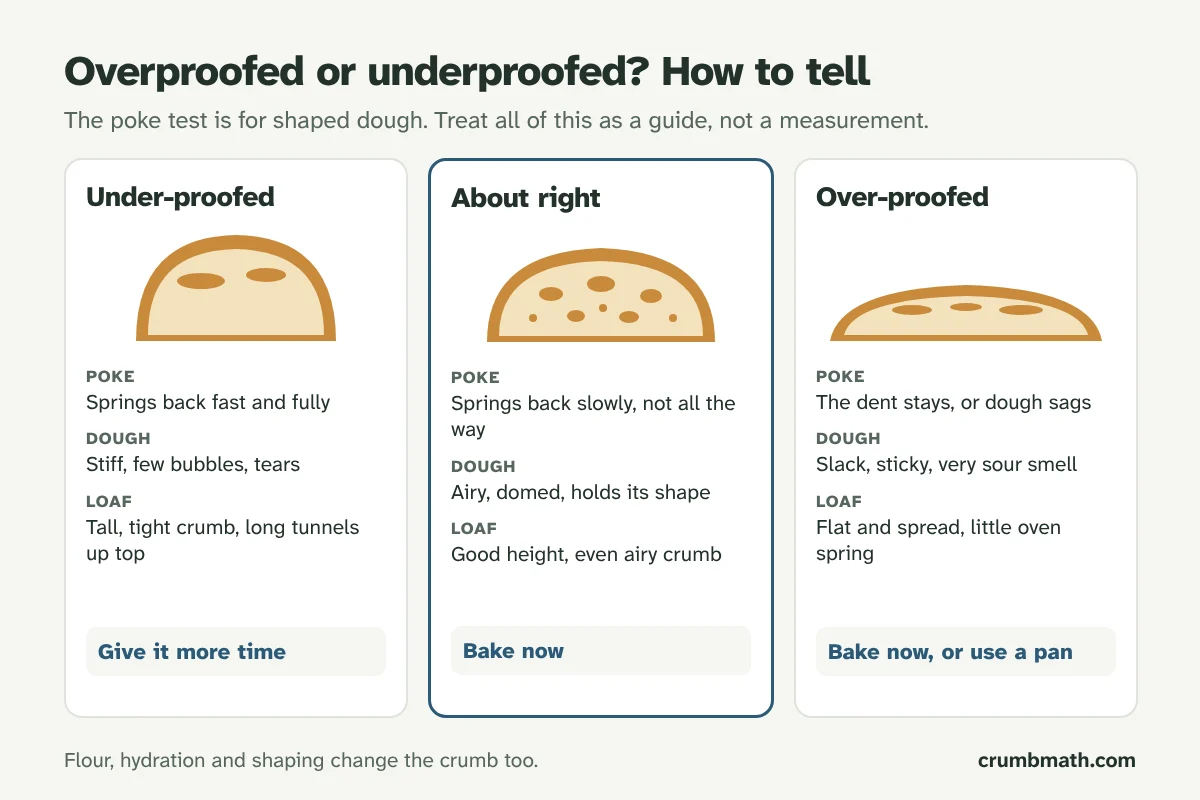
“Is it overproofed or underproofed?” is one of the questions bakers ask most, and it is hard because both can give you a dense loaf. The good news is that each one has its own signs, and many of them show up before the dough goes in the oven, while you can still do something about it.
A note on words: bakers use “proofed” and “fermented” loosely. Strictly, bulk fermentation comes before shaping and proofing after it, but too little or too much of either gives you similar results, so the signs below apply to both.
Before baking: the poke test
Flour a finger and press it gently into the shaped dough. The Perfect Loaf’s guide is the usual reference, and the reading goes like this:
| What the dent does | What it means | What to do |
|---|---|---|
| Springs back quickly and completely | Under-proofed | Give it more time, and test again |
| Springs back slowly, and not all the way | About right | Bake |
| Stays where it is, or the dough sags | Over-proofed | Bake now, or use the rescue below |
Treat it as a guide, not a measurement. Cold dough springs back more slowly than warm dough, so a dent from the fridge reads differently from one on the counter, and very wet dough can be hard to read at all. After a few bakes you learn what your own dough does. The cold proof guide covers the test on fridge-cold dough.
Before baking: how the dough looks and feels
The poke test only works once the loaf is shaped. During bulk, look at these instead:
- Under-fermented: stiff and dense, few bubbles on the sides of the bowl, and it tears rather than stretches.
- About right: bigger and softer than it started, domed where it meets the bowl, with bubbles at the edges. It jiggles a little when you shake the bowl, and still holds its shape when you shape it.
- Over-fermented: very slack and sticky, it will not hold a shape, the dome has collapsed or gone flat, and it smells very sour.
The most reliable check is the rise itself. Put a small sample of the dough in a straight-sided jar at mixing time, and the aliquot jar calculator tells you how far it has risen against your recipe’s target. That takes the guesswork out of a bowl that may have spread sideways instead of up.
After baking: read the loaf
Once the loaf is baked, you can only change the next one, but the shape and crumb tell you which way to go. Let it cool fully before cutting, then look for these:
| What you see | More likely |
|---|---|
| Tall loaf, sometimes with a big ear, and a tight crumb between long tunnels in the upper half | Under-proofed |
| Flat loaf that spread, little oven spring, small or no ear, larger holes just under the crust | Over-proofed |
| Good height, even and airy crumb, small bubbles between the larger ones | About right |
These patterns come from experienced bakers in a Breadtopia forum thread and a Fresh Loaf crumb comparison. The dense or gummy loaf guide goes further, because a gummy crumb can also mean the loaf was underbaked or cut too soon, which has nothing to do with proofing.
The Sourdough Journey also warns that lower-protein flour, hydration below about 70%, or a lot of whole wheat, spelt or einkorn gives a closer crumb even when the timing was right. Compare your loaf with what that kind of dough normally does, not with a photo of a white, high-hydration loaf.
If it is under-proofed: give it time
This is the easy one to fix, because you just wait.
- Still in bulk: let it carry on, and go by the rise rather than the clock.
- Shaped, on the counter: leave it and poke it again in 20 to 30 minutes.
- Straight from the fridge: give it an hour or so on the counter, then test again.
If you keep ending up here, the cause is usually temperature. A recipe’s timings assume a certain dough temperature, and a cool kitchen stretches them a lot. A bulk of 5 hours at 75 °F (24 °C) can take about 7 to 8.5 hours at 68 °F (20 °C), by the rules of thumb in the bulk fermentation calculator. The cold kitchen guide has ways to keep dough warm in winter.
If it is over-proofed: bake it now
You cannot undo over-proofing, but you can stop it getting worse and still end up with something good. Choose by how slack the dough is:
- Still holds some shape: bake it right away, straight from the fridge if it was in there. Cold dough is easier to score and handle. Expect a flatter loaf.
- Too soft to score or lift: tip it into an oiled loaf pan, which gives it the sides it no longer has. Some bakers also reshape it gently and give it a short second proof, but the dough has less strength left, so results vary.
- Very slack and bubbly: press it into an oiled pan and bake it as focaccia, which does not need to hold a shape. The focaccia calculator shows how much dough suits your pan.
Either way, it is safe and usually tastes fine. It may just be more sour and less tall than you hoped. For next time, end bulk earlier, use cooler water or use a little less starter. The starter guide explains how the amount of starter changes the timing.
Which way to go next time
Change one thing per bake, and write down the dough temperature and the rise you stopped at. Otherwise you cannot tell what helped.
| Your loaf was | Try next time |
|---|---|
| Under-proofed | A longer bulk, warmer water, or more starter |
| Over-proofed | A shorter bulk, cooler water, or less starter |
| Different every week | Measure dough temperature and use an aliquot jar, because something is changing that you are not seeing |
Common questions
Is overproofed sourdough safe to eat? A loaf that went a bit too far is safe to eat. It will just be flatter and more sour.
Can you overproof sourdough in the fridge? Yes, but it takes a long time because the cold slows fermentation so much. It is more likely if bulk already ran long, the fridge is warm, or the dough stays there for days.
Why is my sourdough both flat and dense? It is usually over-proofed, but weak shaping or too much water can also make a loaf spread. Under-proofed dough can also spread if it was shaped loosely. How the dough behaved is the best clue.
Is it better to underproof or overproof? Neither is a disaster. Many bakers would rather stop slightly early, because a little under-proofed loaf still rises well, but too far under leaves it dense and gummy.
Does the poke test work on bulk dough? It is meant for shaped dough during its final proof. During bulk, go by the rise, the bubbles and how the dough feels.