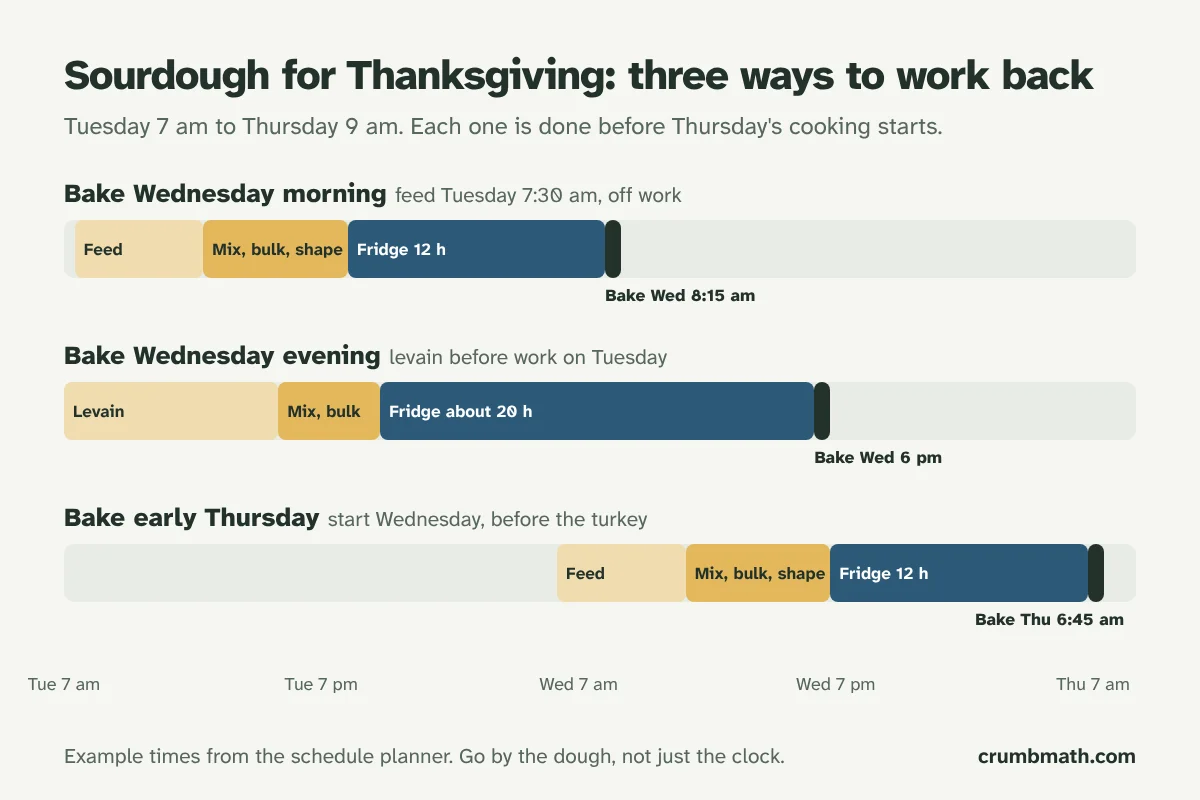
Sourdough takes about a day from feeding the starter to slicing, and on Thanksgiving the problem is rarely the bread. It is the oven, which the turkey has claimed for most of the day. The simplest answer is to get the bread baked before Thursday’s cooking starts, and work back from there.
In 2026, Thanksgiving falls on Thursday, November 26. All the clock times below are examples from our schedule planner, so put your own times in and they will shift. Fermentation depends mainly on temperature, so go by the dough and not just the clock.
The countdown
| When | What to do |
|---|---|
| The weekend before | Bake a practice loaf if you have not baked lately, so a sluggish starter does not surprise you on the day. |
| Sunday or Monday | Take the starter out of the fridge and give it two or three feeds at room temperature before you need it. The fridge guide has the ratios. |
| Before Tuesday | Weigh out your flour, and clear a shelf. The fridge is about to get very full. |
| Tuesday or Wednesday | Start one of the three schedules below. |
Schedule 1: bake Wednesday morning
This suits you if you are off on Tuesday and Wednesday. It uses the planner’s default steps, with the loaf ready to slice at 10:00 am on Wednesday:
| Time | Step |
|---|---|
| Tue 7:30 am | Feed the starter or build a levain |
| Tue 1:30 pm | Mix flour and water, rest |
| Tue 2:30 pm | Add starter and salt, start bulk |
| Tue 7:30 pm | Pre-shape, bench rest |
| Tue 8:00 pm | Final shape |
| Tue 8:15 pm | Into the fridge |
| Wed 8:15 am | Bake (preheat before this) |
| Wed 9:00 am | Cool |
| Wed 10:00 am | Ready |
Schedule 2: bake Wednesday evening, around work
If you work on Tuesday and Wednesday, use the weeknight rhythm from our working full time guide, and let the fridge wait for you:
| Time | Step |
|---|---|
| Tue 7:00 am | Build the levain before work |
| Tue 5:00 pm | Mix flour and water, rest |
| Tue 5:30 pm | Add levain and salt, start bulk |
| Tue 9:00 pm | Pre-shape, bench rest |
| Tue 9:30 pm | Final shape |
| Tue 9:45 pm | Into the fridge |
| Wed 6:00 pm | Bake (preheat before this) |
| Wed 6:45 pm | Cool |
| Wed 7:45 pm | Ready |
That bulk is about 3.5 hours because it assumes dough at about 75 °F (24 °C). In a cooler November kitchen it will take longer, so warm the dough with the water temperature calculator or expect to shape later. The cold proof here is about 20 hours, which tends to give a more sour loaf with a little less rise. The cold proof guide explains what to expect and how to test it.
Schedule 3: bake early on Thursday, before the turkey
You want the freshest possible loaf, and you are up early anyway. This uses the planner’s default steps, with the loaf ready to slice at 8:30 am on Thursday:
| Time | Step |
|---|---|
| Wed 6:00 am | Feed the starter or build a levain |
| Wed 12:00 pm | Mix flour and water, rest |
| Wed 1:00 pm | Add starter and salt, start bulk |
| Wed 6:00 pm | Pre-shape, bench rest |
| Wed 6:30 pm | Final shape |
| Wed 6:45 pm | Into the fridge |
| Thu 6:45 am | Bake (preheat before this) |
| Thu 7:30 am | Cool |
| Thu 8:30 am | Ready |
Check when your turkey has to go in first, and leave time for the oven to come down from baking temperature. Sourdough bakes hot, at around 425 °F (220 °C) in our baking time guide, which is usually hotter than you want for the bird. If the timing is tight, use Schedule 1 or 2.
How much dough for your table
The recipe calculator turns any dough weight into grams. As a rough way to size it, a finished loaf weighs about 15% less than its dough. So 900 g of dough gives a loaf of about 765 g. At an assumed 50 g per slice, that is about 15 slices. Slices vary a lot, and bread is rarely the main event on this table, so adjust to suit your guests.
For 900 g of dough at 70% hydration, with 20% starter and 2% salt:
| Ingredient | Weight |
|---|---|
| Flour to add | 471 g |
| Water to add | 314 g |
| Starter (100% hydration) | 105 g |
| Salt | 10 g |
If you want two loaves, double it, but check that your bowl and fridge can hold it all. A Dutch oven usually takes one loaf at a time, so allow for a second bake and for reheating the pot in between.
Rolls instead of a loaf
The same weights work for plain sourdough rolls: 900 g of dough makes 12 rolls of 75 g each. Rolls need shaping one by one and take much less time in the oven than a loaf, so follow your recipe’s baking time. Soft dinner rolls made with milk, butter or sugar usually bake cooler than a crusty loaf too, and those added ingredients change the timing, so treat these schedules as a rough guide and go by your recipe.
Keeping it fresh until dinner
- Baked Wednesday: cool it fully, then keep it at room temperature, cut side down once sliced, or in a bread bag. A plastic bag softens the crust.
- Refresh it: if the crust has softened, a few minutes in a hot oven brings it back. The turkey’s resting time is a good moment, when the oven is free.
- Bake further ahead: cool the loaf fully, wrap it well and freeze it. Thaw it wrapped, at room temperature, then refresh it in the oven.
- For stuffing: bake an extra loaf early in the week, and let the cubes dry out before you use them. Stale bread holds its shape better than fresh.
If something goes wrong
- The dough is behind on Tuesday night. Let it finish. A later shape just means a shorter cold proof, and even a few hours in the fridge helps with scoring.
- Your plans change on Wednesday. Leave it in the fridge. An extra day usually beats baking at a bad time, though it may go a little sour or lose some height.
- The fridge is full. A cool garage or porch can work on a cold night, but the temperature varies. Use a thermometer, and remember that a warmer spot is not doing the same job as a fridge at about 39 °F (4 °C), so check the dough sooner.
- The dough looks flat and slack. See overproofed or underproofed for how to tell, and how to rescue it.
Common questions
How far ahead can I bake sourdough for Thanksgiving? The day before is the easiest, and it still slices well. For anything earlier, freezing a fully cooled, well-wrapped loaf works better than leaving it out.
Can I shape the dough on Tuesday and bake on Thursday morning? It would be about 36 hours in the fridge. Many doughs can take that, but the longer it waits the more likely it is to lose strength or over-proof, so try it before the day if you can. The cold proof guide has the details.
Can I bake while the turkey is in the oven? It is rarely a good idea. Sourdough wants a hotter oven than most turkeys, and a Dutch oven takes up a lot of space.
When should I take my starter out of the fridge? Two or three days before you need it, so it has time for two or three feeds and is rising reliably.