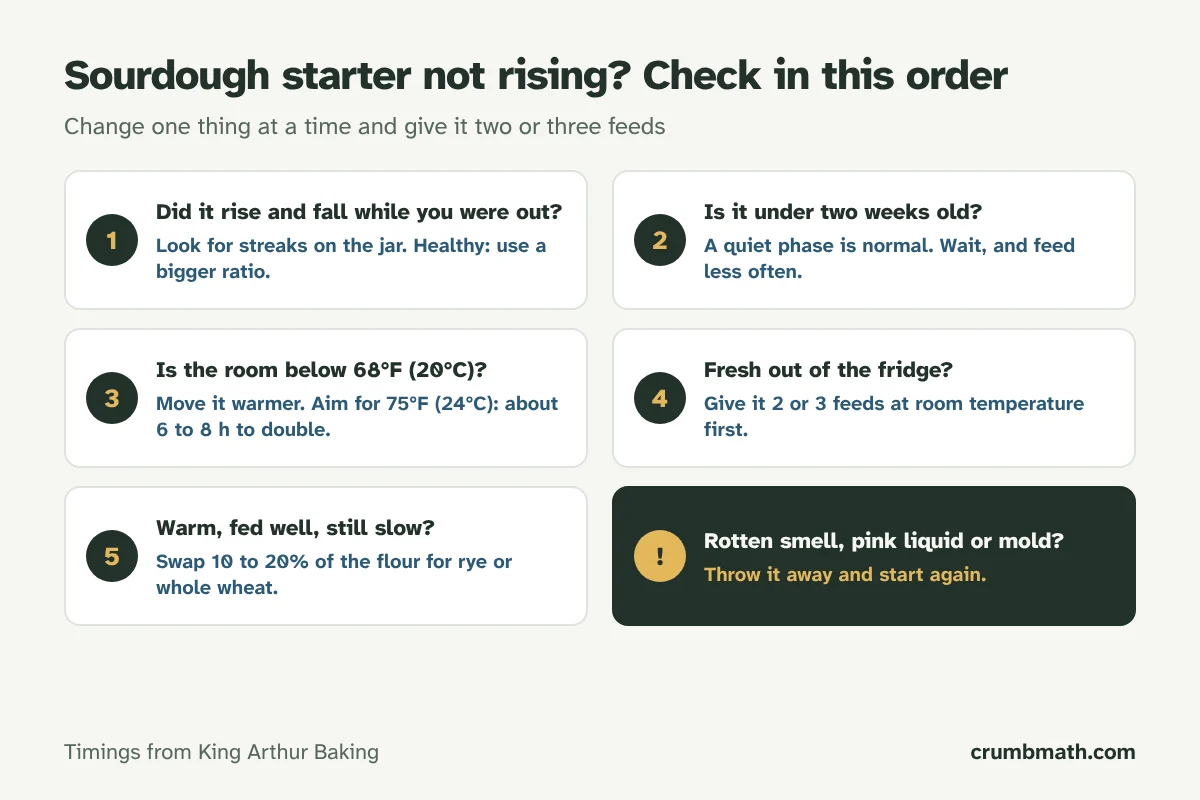
A starter that will not rise is one of the most common sourdough worries, and it is rarely dead. Most of the time the culture is fine and something about its conditions is holding it back. Work through the causes below in order, change one thing at a time, and give each change a couple of feeds before you judge it.
First, check that it really is not rising
A starter that rose and fell back while you were out looks exactly like one that never rose. Before you change anything:
- Put a rubber band or a strip of tape on the jar at the level right after feeding.
- Look for streaks or a dried film on the glass above the starter. That is the high-water mark of a rise you missed.
- Check the smell and texture. A starter that has peaked and fallen is runnier and smells sharper than one that has barely started.
If it is rising and falling while you are not watching, it is healthy and simply faster than your schedule. Feed it at a bigger ratio so it peaks later. The feeding ratios guide explains how the ratio sets the timing.
A new starter that suddenly goes quiet
This is normal and catches out almost every beginner. A new starter often bubbles up in the first few days, then goes flat during its first week or two. King Arthur notes that a new starter may stop rising for a week or more even with regular feeding, before it settles into a steady rhythm. The early burst is not yet the yeast and bacteria you want; those take time to establish as the starter becomes more acidic.
What to do: keep going, and do not feed it more often to “help”. In a Fresh Loaf thread about a new starter that stalled, experienced bakers explained that feeding too frequently keeps diluting a culture that is still building up, and advised leaving it a day or more and feeding by activity rather than by the clock. The baker waited about 36 hours, saw it double, and it recovered from there. If you are still in the first couple of weeks, the day-by-day plan for a new starter shows what to expect on each day.
It is too cold
Temperature matters more than anything else you can change. King Arthur says a healthy starter should double in about 6 to 8 hours at 75°F (24°C) or warmer, and that below 68°F (20°C) it can take much longer. In a cool kitchen, a starter can look dead when it is only slow.
What to do:
- Find a warmer spot: on top of the fridge, near (not on) a heater, or in the oven with only the light on. Check the temperature with a thermometer rather than guessing.
- Feed it with warm water. King Arthur suggests water at 80°F to 90°F (27°C to 32°C).
- Use a smaller ratio such as 1:2:2 while it is cold, so there is less fresh flour to work through.
The cold kitchen guide has more ways to keep starter and dough warm in winter.
It is fed too often, or the ratio is too big for your kitchen
A starter needs time to grow through its fresh flour before it rises. If you feed it again before it has peaked, or give it a big feed like 1:10:10 in a cool room, it may never get the chance to show a full rise.
| What you see | Likely problem | Try |
|---|---|---|
| Small rise, then you feed again | Feeding before it peaks | Wait for the peak before the next feed |
| Hardly moves for 12 hours after a big feed | Ratio too big for the temperature | Drop from 1:5:5 or 1:10:10 to 1:2:2 |
| Rises and falls well before your next feed | Ratio too small for the temperature | Raise the ratio so it peaks later |
The starter feeding calculator turns any ratio into grams, so you can change the ratio without changing how much starter you end up with.
It just came out of the fridge
A starter kept cold for a week or two is sluggish for the first feed or two. King Arthur describes it as having gone to sleep, and says a series of regular feeds brings it back. Grey liquid on top is normal; pour it off or stir it in.
Give it two or three feeds at room temperature before you judge it. The fridge guide covers which ratio to use for the first feed.
It needs more food: try some whole grain flour
If it is warm, fed at a sensible ratio and still slow, change the flour. Whole grain flours carry more of the nutrients the yeast and bacteria feed on. King Arthur suggests replacing 10% to 20% of the white flour in each feed with rye, whole wheat or pumpernickel.
For a 20 g starter fed at 1:5:5, that means 80 to 90 g of white flour plus 10 to 20 g of rye, with the usual 100 g of water.
Other things that slow a starter down
- It is a stiff starter. A starter kept at around 50% hydration rises more slowly than a 100% one. See the stiff starter guide.
- You are measuring by volume. A cup of bubbly starter weighs much less than a cup of settled starter, so the ratio changes from feed to feed. Weigh everything.
- The jar is too big. A 2 cm rise in a wide jar is the same amount of growth as a much taller rise in a narrow one. A straight-sided jar makes the rise easier to read.
When to throw it away
Most sluggish starters can be revived. King Arthur’s warning signs that it has gone bad are a rotten or off smell, a pinkish liquid, or visible mold. If you see any of those, throw it away and start again rather than trying to save it.
Common questions
How long should a starter take to double? King Arthur says 6 to 8 hours at 75°F or warmer for a healthy starter. Cooler kitchens, bigger feeding ratios and stiffer starters all take longer, so use your own starter’s timing as the guide.
Can I bake with a starter that does not double? Some bakers do, but the dough will ferment more slowly and the result is less predictable. It is easier to get the starter rising reliably first.
Should I feed a sluggish starter more often? Not usually. Feeding before it has risen keeps diluting it. Give it a warmer spot and time to peak, then feed.
Is the hooch, the grey liquid on top, a sign it is dying? No. It means the starter is hungry. Pour it off or stir it in and feed it.