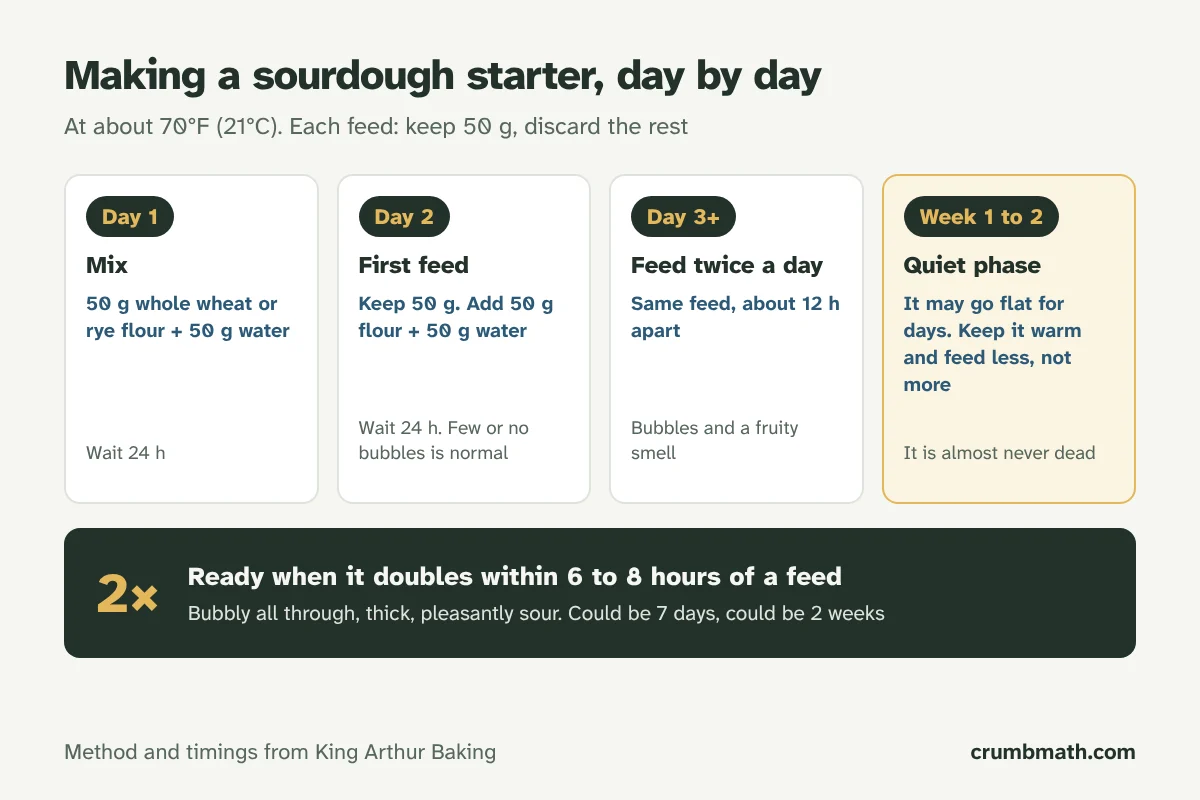
A sourdough starter is just flour and water left somewhere warm and fed regularly until the wild yeast and bacteria in it are strong enough to raise bread. You don’t need to buy anything special or add anything else. What you do need is a scale, a jar and some patience: most of the work is waiting, and the most common mistake is giving up, or feeding too often, during the slow patch in the first week or two.
The plan below follows King Arthur Baking’s sourdough starter recipe, which was updated in February 2026 to make a smaller starter (50 g feeds instead of the older, larger ones). Smaller feeds mean less flour thrown away while the starter gets going.
What you need
- Whole wheat or rye flour for the first day. King Arthur starts with whole grain flour (whole wheat or pumpernickel, which is a coarse rye).
- All-purpose or bread flour for the feeds after that.
- Water. Adjust its temperature to your kitchen: cool water if the house is warm, lukewarm if it is cool.
- A non-reactive container such as a glass jar, with a loose lid or a cloth over the top.
- A kitchen scale. Weighing is far more reliable than cups for this.
- A warm spot. About 70°F (21°C) is a good target. King Arthur suggests finding a smaller, warmer spot if your home is below 68°F (20°C).
Day by day
| Day | What to do | Then |
|---|---|---|
| 1 | Mix 50 g whole wheat or rye flour with 50 g water | Leave 24 hours |
| 2 | Keep 50 g, discard the rest, add 50 g flour and 50 g water | Leave 24 hours |
| 3 to 5 | Twice a day, about 12 hours apart: keep 50 g, discard the rest, add 50 g flour and 50 g water | Repeat |
| 6 onward | Keep feeding twice a day until it passes the readiness test below |
No scale? King Arthur gives 50 g whole wheat flour as about 7 tablespoons, 50 g all-purpose flour as about 6 tablespoons and 50 g water as a scant 1/4 cup. Weighing is still more reliable.
That is a 1 : 1 : 1 feed (starter : flour : water) at 100% hydration. The starter feeding calculator shows the same numbers and scales them if you want a bigger or smaller starter.
Day 1. Stir the flour and water together until no dry flour is left. It will be a thick paste. Cover loosely and leave it in your warm spot for 24 hours.
Day 2. You may see nothing at all, or a few bubbles and a little growth. King Arthur says either is normal at this stage. Weigh out 50 g, discard the rest, then stir in 50 g all-purpose flour and 50 g water. Leave it another 24 hours.
Days 3 to 5. Move to two feeds a day, as evenly spaced as your schedule allows. Each time, keep 50 g, discard the rest and feed 50 g flour and 50 g water. King Arthur’s guide says that by day 3 you may see bubbling, a fresh, fruity smell and some sign of expansion.
Why throw so much away? Without discarding, the starter doubles in size every feed and you would need ever bigger feeds to keep it fed properly. Keeping a small amount and feeding it well is what builds a strong culture. Many bakers throw away the discard from the first few days and only start cooking with it once the starter is established and smells pleasantly sour. The discard guide has ideas, and the discard calculator adjusts a recipe’s flour and liquid when you add it.
The quiet phase: why it goes flat
This is the part that worries most beginners. A new starter often bubbles up excitedly in the first two or three days, then goes flat and does very little for days. It looks dead. It almost certainly isn’t.
The early burst usually isn’t the yeast you want yet. King Arthur notes that a new starter may stop rising for a week or more even with regular feeding before it settles into a steady rhythm.
What helps during this phase:
- Keep it warm. In a Fresh Loaf thread from a baker whose seven-day-old starter had gone quiet, experienced bakers suggested keeping it at around 75 to 78°F (24 to 26°C).
- Feed less, not more. The same bakers’ advice was to slow down: if there is no activity, stir it every 12 hours instead of feeding, and let the starter tell you when it needs the next feed. Feeding a weak culture over and over just keeps diluting it. The original poster stopped feeding for several days and the starter “finally woke up”.
- Check your water. One reply pointed out that chlorinated tap water can be a problem. If you suspect yours, filtered water is an easy thing to try.
- Look at the jar, not the calendar. Put a rubber band at the level just after feeding, so you can see if it rose and fell while you were out.
If it is still sluggish after a couple of weeks, work through the starter not rising guide, which covers temperature, feeding ratio and flour in more detail.
How to tell it is ready
The test is the same one King Arthur uses: a ready starter at least doubles in volume within 6 to 8 hours of a feed, at a warm room temperature. It should also:
- be full of bubbles, top to bottom
- be thick and viscous, not thin and watery
- smell pleasantly sour and clean, not harsh
King Arthur puts it plainly: this could happen in 7 days or less, or take up to a couple of weeks. Watch for the doubling, not the date. If yours takes longer than the recipe says, that is normal, especially in a cool kitchen.
Once it passes the test on two or three feeds in a row, you can bake with it. Build the amount the recipe needs with a final feed (the levain calculator works out how much to mix), and keep a little back to carry on with.
Keeping it going after that
You don’t have to feed it twice a day forever. Once it is established, most home bakers keep it in the fridge and feed it about once a week. King Arthur’s guide recommends a weekly feed for a refrigerated starter, and the feeding from the fridge guide covers how to wake it up before a bake. If you bake often, you can keep it on the counter and use a bigger feeding ratio so it peaks less often; the feeding ratios guide explains how.
When to throw it away and start again
A watery grey or dark layer on top is “hooch”, a sign the starter is hungry. Stir it in or pour it off and feed. That is not a reason to start again.
King Arthur’s advice is to discard the starter if you see mold, an orange or pink tint or streak, or a putrid smell. Wash the jar well and start over from day 1.
Common questions
How long does it take to make a sourdough starter? King Arthur’s recipe is planned as about 5 days, but its guide says it could be 7 days or less, or up to a couple of weeks. It is ready when it doubles within 6 to 8 hours of a feed, however long that takes.
Can I use all-purpose flour from day 1? You can. King Arthur starts with whole grain flour (whole wheat or pumpernickel) on day 1, so that is what this plan follows, then switches to all-purpose for the feeds.
Do I need to add yeast, sugar, grapes or pineapple juice? No. Flour and water are enough. Some bakers use other tricks to get past a slow start, but the plan above works without them.
How much flour will this use? At 50 g feeds, roughly 400 g of flour for the first five days, and more if it takes longer. That is part of why the recipe moved to smaller feeds.
Can I make it bigger? Yes. Keep the 1 : 1 : 1 proportions and scale all three numbers. The starter feeding calculator does the arithmetic.