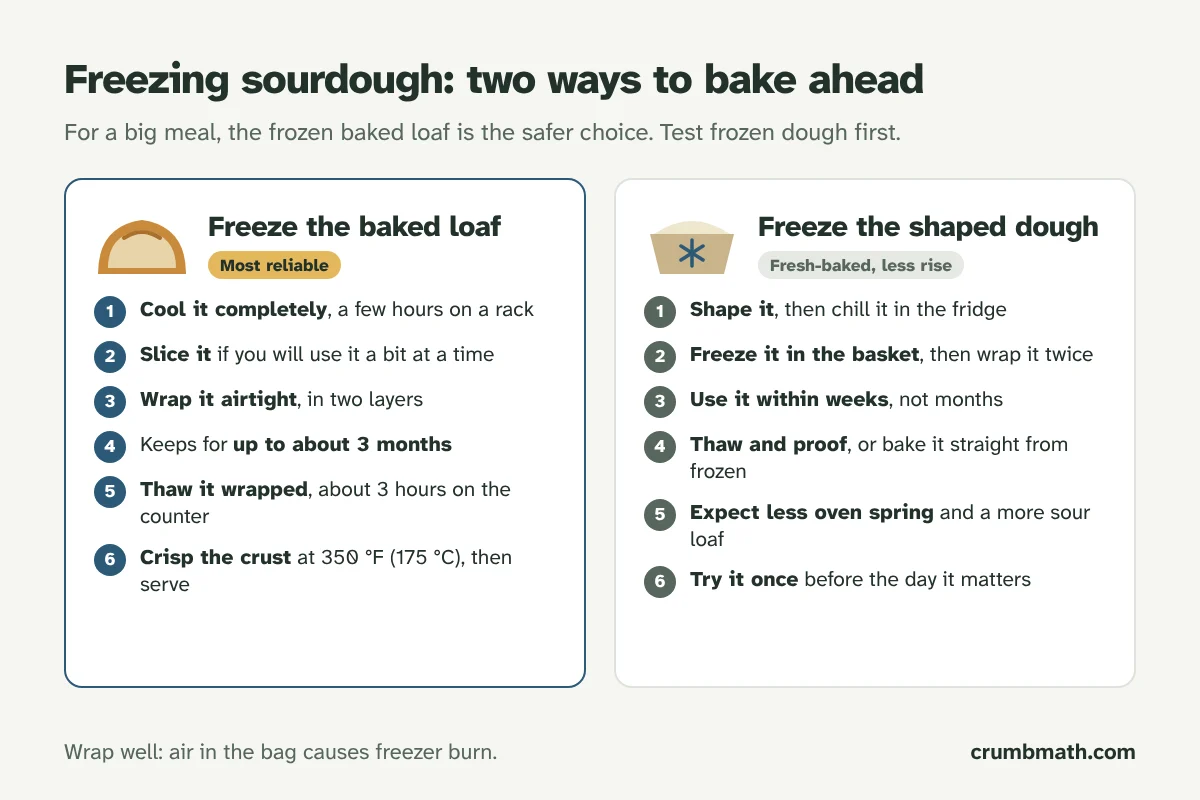
Freezing is the easiest way to have good sourdough on the table for Christmas or New Year without baking on the busiest day. You have two choices: freeze a finished loaf, or freeze the shaped dough and bake it later. Both work, but they are not equally reliable.
The short version: freeze the baked loaf when the bread has to be right, and freeze dough when you want the smell of fresh bread and can live with a slightly lower loaf.
Option 1: freeze the baked loaf
This is the method with the least that can go wrong. King Arthur’s freezing guide says properly frozen and thawed bread is “about 90% as good” as fresh, and a crusty sourdough loaf comes back well once the crust is crisped in the oven.
- Cool it completely. Give it at least a few hours on a rack. Wrapping a warm loaf traps steam, which makes the crust soggy and can lead to mold.
- Slice it first, if you will use it a bit at a time. You can take out only the slices you need, and frozen slices go straight into the toaster. Keep a loaf whole if you want to serve it whole.
- Wrap it airtight, in two layers. For example, plastic wrap or foil, then a freezer bag with the air pressed out. King Arthur recommends “multiple airtight layers”. Air in the bag is what causes freezer burn and stale, dry edges.
- Label it and freeze it. King Arthur says most bread keeps for up to three months. It is still safe after that, but the quality slowly drops, so for a holiday loaf a few weeks is better than a few months.
Thawing and refreshing a baked loaf
- Thaw it in its wrapping, at room temperature. A whole loaf takes about three hours, by King Arthur’s guide. Keeping it wrapped lets the crumb take back the moisture that froze on the surface.
- Crisp the crust. Unwrap it and put it in a 350 °F (175 °C) oven until the crust is crisp again and the loaf is warm through. Tent it with foil if it starts to get too dark. Times vary with the size of the loaf, so check it after about 10 minutes.
- Serve it soon after. A refreshed loaf goes stale faster than a fresh one, so warm it close to the meal.
- Avoid the microwave for a whole loaf. It warms it unevenly and makes the crust chewy.
Option 2: freeze the shaped dough
Freezing dough lets you bake on the day, but yeast and bacteria do not all survive freezing, and the dough is weaker when it thaws. Every source we read agrees on when to freeze it: after shaping. They disagree on almost everything else, so treat the times below as starting points.
| Northwest Sourdough (a test of two loaves) | Farmhouse on Boone | The Pantry Mama | |
|---|---|---|---|
| When to freeze | Chilled, shaped, in the basket | After bulk and shaping | After shaping and the cold proof |
| How long | “Days or weeks instead of months” | Up to a month | Up to 3 months |
| How to bake | Thaw in the fridge, final proof, bake | Thaw in the fridge or on the counter, then bake | Bake from frozen |
| What they found | Good flavor, but little oven spring, “like it was over-proofed” | Bakes up well | Best result of the stages tested |
How to freeze dough
- Mix, bulk and shape as usual. Many bakers end bulk a little early so the dough is not near its limit before it freezes.
- Chill it first. An hour or two in the fridge, or a full cold proof if you plan to bake from frozen, firms the dough and slows it down so it does not keep rising while it freezes.
- Freeze it in the basket or a lined container until solid, then turn it out, wrap it airtight in two layers and put it back. This keeps its shape and frees the basket.
- Use it soon. The longer it sits, the less it rises. Within a couple of weeks is safest.
Baking frozen dough
There are two ways, and you may need to try both with your own dough.
- Thaw, proof, then bake. Unwrap the dough, put it back in a floured basket, cover it and thaw it in the fridge overnight, then let it finish proofing at room temperature before you bake. Use the poke test to decide when it is ready, not the clock. The overproofed vs underproofed guide shows how to read it. Expect this to take hours, and longer in a cool kitchen.
- Bake straight from frozen. The Pantry Mama bakes the frozen loaf on parchment in a preheated Dutch oven for 45 minutes with the lid on and 15 minutes with it off. Times depend on your oven and loaf, so check that the center is fully baked. The baking time guide gives internal temperatures to aim for.
Either way, expect a loaf that is a little lower and a little more sour than one baked from fresh dough. If that is a problem, bake the bread first and freeze the finished loaf instead.
A bake-ahead plan for Christmas
This is one way to do it. Move the dates to suit your own calendar.
- One or two weeks before: bake your loaves on a free weekend. The schedule planner works out when to feed your starter for a bake at the time you want.
- The same day: cool the loaves fully, slice any you will use for toast or sandwiches, wrap everything twice and freeze it.
- The day you serve it: take the loaf out about three hours before the meal, leave it wrapped on the counter, then refresh it in the oven just before you sit down.
If you want to freeze dough for the day itself, do a test run first. Freeze one shaped loaf, then thaw and bake it the way you plan to. That tells you how your dough, flour and freezer behave before it matters.
Freezing your starter
You can freeze starter too, either as a backup or so a holiday away does not mean finding a starter-sitter. A starter in the fridge usually keeps for weeks between feeds, so freezing is mostly for longer gaps or a spare copy. The fridge starter guide covers that route.
- Freeze it active. The Pantry Mama feeds the starter a few hours before, freezes it in small portions in an ice cube tray, then moves the frozen pucks to a sealed, labelled bag.
- How long: she says up to 12 months, with more yeast dying off the longer it waits. Modernist Cuisine, which freezes levain to use straight in a dough, says it performs well for up to 2 weeks.
- To revive it: thaw a portion at room temperature until it is liquid again, then feed it as you would a sluggish starter, discarding and feeding until it reliably doubles. The Pantry Mama expects that to take 2 to 3 feeds. The starter not rising guide helps if it is slow to come back.
For a backup that sits in a cupboard for months, or one you can post to a friend, you can dry your starter instead.
If something goes wrong
- The thawed loaf is soggy. It was probably wrapped while still warm. Crisp it longer in the oven, unwrapped.
- Dry, pale patches on the crust. That is freezer burn from air in the bag. Cut off the worst of it. Next time, press out more air and add a second layer.
- Frozen dough spread and barely rose. It lost strength in the freezer, or it proofed too long after thawing. Bake the next one from frozen, or bake it in a loaf pan, which holds the dough up. The flat sourdough guide covers other causes.
Common questions
How long does sourdough bread last in the freezer? Wrapped airtight, a baked loaf keeps its quality for up to about three months. It stays safe to eat longer, but it slowly dries out and picks up freezer flavors, so use it sooner if you can.
Should I slice sourdough before freezing it? Slice it if you will eat it a few slices at a time, because you can toast slices straight from frozen. Freeze it whole if you want to serve a whole loaf at the table.
Can you freeze sourdough dough? Yes, it works best after shaping. Expect it to rise less after freezing, and use it within a few weeks. Bakers disagree on whether to thaw it first or bake it straight from frozen, so test your own dough before an important meal.
Can I freeze dough before bulk fermentation? You can, but it is less reliable. The dough has to thaw and then do its whole bulk with a weakened starter. The Pantry Mama found that freezing before shaping hurt the dough’s structure, and the sources we read all freeze after shaping.
Can I freeze my sourdough starter? Yes. Freeze it soon after a feed, in small portions, and expect it to need 2 or 3 feeds after thawing before it is ready to bake with. For breaks of a few weeks, the fridge is simpler.