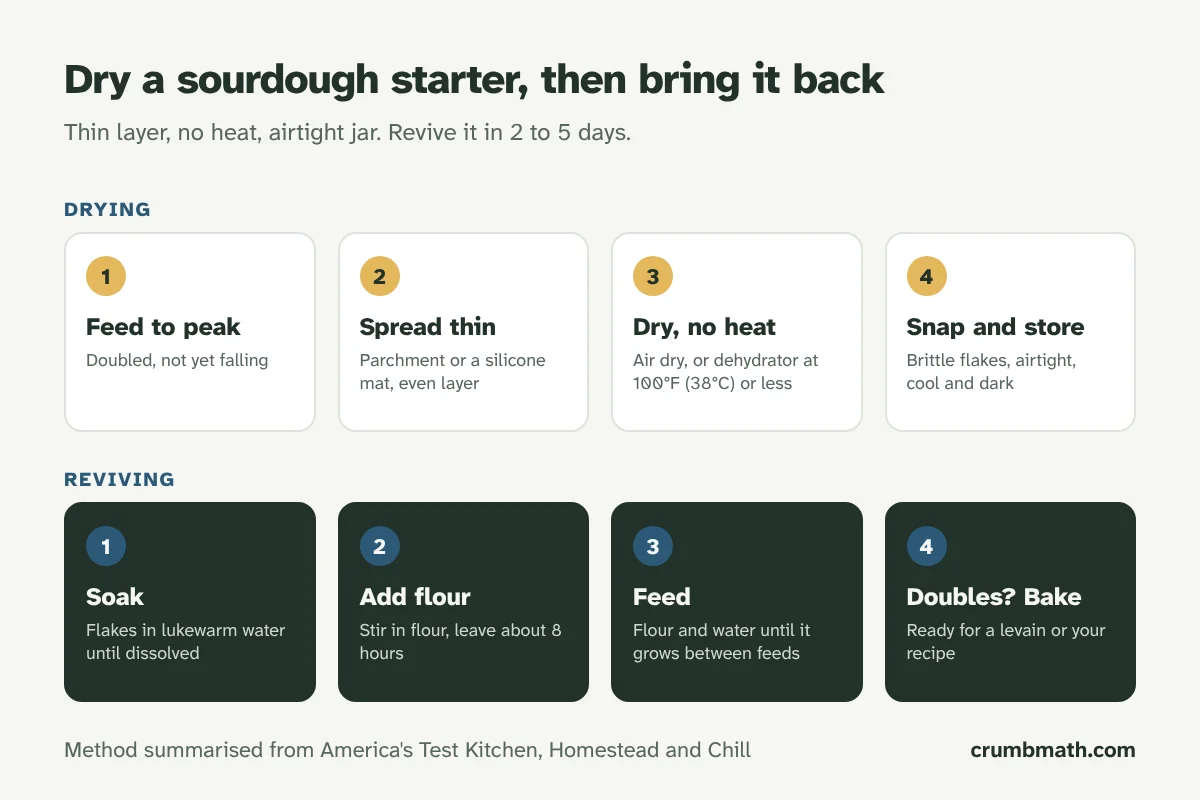
A dried sourdough starter is your starter with the water taken out. The yeast and bacteria go dormant instead of dying, and you get brittle flakes that keep for months in a jar. It is a good backup in case your starter gets neglected or contaminated, it is easy to take on a trip, and it fits in an envelope if you want to give some away for the holidays.
What you need
- An active starter, fed and at or near its peak
- Parchment paper or a silicone baking mat
- A spatula or bench scraper
- A clean, airtight jar or zip-lock bag
- A food dehydrator (optional)
Step 1: Feed it and wait for the peak
Dry the starter when it is at its strongest. Homestead and Chill suggests drying it once it has at least doubled after a feed but has not started to fall. They note that unfed discard can be dried too, but it is slower to revive. If you are not sure when your starter peaks, the feeding ratios guide explains how the ratio and temperature set the timing.
Step 2: Spread it as thin as you can
Spread the starter in a very thin, even layer on parchment or a silicone mat. Thin is the whole trick: it dries faster and more evenly, and thick patches stay damp in the middle. Homestead and Chill’s guide says about 1 cup of starter covers a 14 x 14 inch (36 cm) dehydrator tray.
Step 3: Dry it without heat
You have two options.
- At room temperature. Leave it somewhere cool, dry and well ventilated. America’s Test Kitchen covers the tray with a thin cloth to keep dust and insects off, and their method gives 2 to 5 days, depending on humidity. A thin layer in a warm, dry room can be done much sooner: The Art of Doing Stuff reports 6 to 12 hours. Humid weather slows it down.
- In a dehydrator. Keep it low. The Art of Doing Stuff sets 90°F (32°C) and says to stay at or below 100°F (38°C). Homestead and Chill says 105°F (about 40°C) or less, with 90 to 95°F best, and usually runs theirs for about a day.
Do not use a heated oven. Homestead and Chill points out you can leave the tray in an oven that is switched off (with only the fan running, if it has one), but turning the heat on will kill the culture.
It is done when it is completely dry and brittle, and snaps when you bend it. If any part still bends, give it longer.
Step 4: Break it up and store it
Peel the dried sheet off the paper and break it into flakes, or crush it into a coarse powder. America’s Test Kitchen crushes it inside a zip-lock bag, and warns against using a spice grinder unless it is spotless, because spice residue can harm the culture.
Store it in an airtight container in a cool, dark, dry place. Moisture and heat are what shorten its life, and Homestead and Chill does not recommend freezing it.
How long does dried starter keep?
Sources differ. America’s Test Kitchen suggests using it within a year. Homestead and Chill reports reviving starters well over a year old. Either way, it tends to lose vigour over time, so older flakes may need an extra feed or two before they are lively again. Label the jar with the date.
How to revive dried starter
The idea is always the same: dissolve the flakes in water, add flour, then keep feeding until the starter doubles reliably between feeds. Here is America’s Test Kitchen’s method, with approximate grams added:
| Step | What to do | Wait |
|---|---|---|
| 1 | Mix 2 tablespoons of dried flakes with ¼ cup (about 60 g) lukewarm water | 1½ to 2 hours, stirring now and then, until dissolved |
| 2 | Stir in 1½ oz (about 43 g) all-purpose flour | 8 hours |
| 3 | Stir in 1½ oz flour and 1½ oz water (about 43 g each). Repeat once or twice | Until it grows about 25% between feeds |
| 4 | Keep 2 oz (about 57 g) and feed it 2 oz flour and 2 oz water. Repeat once or twice | Until it doubles between feeds |
Once it doubles, it is ready to build a levain or use in a recipe. Most methods take 2 to 5 days, depending on how old the flakes are and how warm your kitchen is. The Art of Doing Stuff uses a slower plan with smaller feeds once a day and says the starter is ready to bake with in under a week.
If it seems slow, keep it somewhere warmer (King Arthur says a healthy starter doubles in 6 to 8 hours at 75°F, 24°C, or warmer) and be patient. The starter not rising guide covers the usual causes.
After it is back
Feed it as you normally would. The starter feeding calculator works out how much flour and water to add for any ratio, and shows the hydration you end up with.
Giving dried starter as a gift
Put a tablespoon or two of flakes in a small zip-lock bag or jar and include the revival steps above. A tablespoon of flakes is plenty to start from, since the starter grows with every feed. Mention which flour you feed it, because a starter tends to settle in fastest on the flour it is used to.
Common questions
Can I dry discard instead of active starter? Yes, but it revives more slowly. Active starter at its peak gives the strongest flakes.
Does drying change the flavour? It is the same culture, so once it is fully revived and fed on its usual schedule it should behave like before. The first few feeds after reviving are often slower.
Is drying better than freezing? Both work as a backup. Frozen starter usually comes back in 2 or 3 feeds but needs freezer space; dried flakes take a few days to revive but keep in a cupboard and post easily. The freezing guide covers the frozen route.
Can I just keep my starter in the fridge instead? For a few weeks, yes. The fridge guide explains how to wake it up. Drying is better for months away, or for a backup you can forget about.